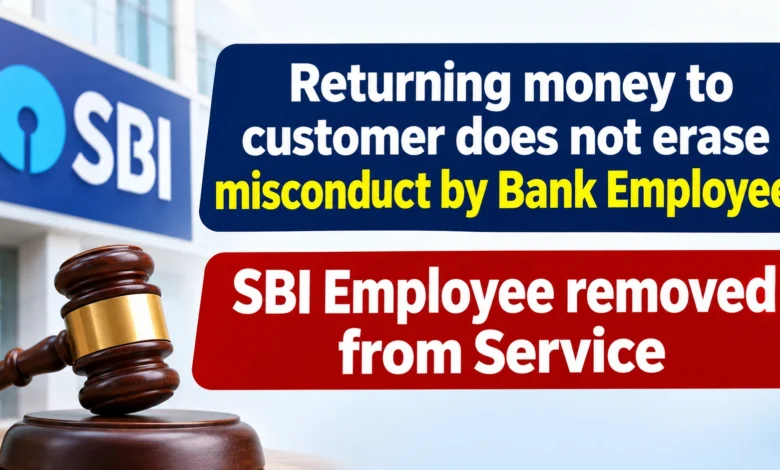
Returning money to customer does not erase misconduct by Bank Employee, SBI Employee removed from Service

| ➡️ Click here to Join Whatsapp News Group - Get instant updates of all Banking News |
The Calcutta High Court has upheld the dismissal of a State Bank of India (SBI) employee who was found guilty of repeatedly violating banking procedures while handling customers’ accounts and financial transactions. The court observed that returning the money to customers does not erase misconduct, even if the bank has not suffered any financial loss.
Justice Partha Sarathi Chatterjee delivered the order on November 20, 2026, while hearing a petition filed by the former SBI employee challenging his dismissal from service.
The court ruled that bank employees must maintain honesty, integrity and follow prescribed procedures while handling customers’ money. A subsequent refund or adjustment cannot make an unauthorised transaction legitimate.
What Is the Case?
The case relates to an SBI employee who was working as an Assistant at a bank branch. The employee was accused of committing several irregularities while handling customers’ accounts and financial transactions. The bank initiated disciplinary proceedings against him and eventually removed him from service.
The employee challenged the dismissal before the Calcutta High Court, arguing that the departmental enquiry was unfair and that the punishment was excessive.
He also claimed that the transactions were either genuine mistakes or had been carried out with proper instructions. According to him, the money involved in the transactions had eventually been refunded to the customers.
What Were the Allegations Against the SBI Employee?
The bank levelled six major misconduct charges against the employee. The allegations included the following financial irregularities:
- Double debit of Rs 1,000: An amount of Rs 1,000 was allegedly debited twice from a customer’s account.
- Unauthorised transfer of Rs 7,000: The employee allegedly transferred Rs 7,000 from his father’s account without proper authorisation.
- Payment of Rs 6,000 without signature verification: He allegedly made a payment of Rs 6,000 without properly verifying the customer’s signature.
- Unauthorised transfer of Rs 60,000: An amount of Rs 60,000 was allegedly transferred without the required authorisation.
- Failure to credit Rs 6,000: The employee allegedly failed to credit a customer’s deposit of Rs 6,000 into the account.
The employee denied the allegations and claimed that the transactions were either mistakes or were made with proper instructions.
How Did SBI Take Disciplinary Action?
According to the case details, the bank first sought an explanation from the employee. However, after considering the matter, SBI suspended him in January 2015.
In April 2015, the bank issued a chargesheet containing six allegations of major misconduct.
The employee challenged the disciplinary proceedings, claiming that the chargesheet was vague and did not initially contain the required lists of documents and witnesses.
A departmental enquiry was subsequently conducted. The employee denied the charges and provided explanations regarding each transaction.
However, the enquiry officer found him guilty of five out of the six charges. In December 2015, the Disciplinary Authority ordered his removal from service.
The employee then filed an appeal against the punishment, but the bank rejected his appeal in March 2016. After exhausting the departmental appeal process, he approached the Calcutta High Court.
What Did the SBI Employee Argue Before the High Court?
The employee challenged the dismissal on several grounds. Senior advocate Sardar Amjad Ali and advocate Arun Kr Das, appearing for the employee, argued that the departmental enquiry was unfair and that the bank had not properly considered his explanations.
His lawyers raised the following arguments:
- The chargesheet mentioned a provision relating to minor misconduct, whereas the bank imposed a major punishment of removal from service.
- The chargesheet did not initially contain the required lists of documents and witnesses.
- The bank failed to provide certain relevant documents despite the employee’s written request.
- The employee was not given a fair opportunity to defend himself.
- The transactions were either genuine mistakes or had been carried out with proper instructions.
- The customers had eventually received refunds, and therefore, the punishment of removal from service was excessive.
The employee requested the High Court to set aside the disciplinary proceedings and the order removing him from service.
What Did SBI Argue Before the Court?
Advocates S K Sinha and Sanchita Dey Pal Chaudhury, appearing for SBI, defended the bank’s decision. The bank argued that refunding the money to customers could not erase the misconduct committed by the employee.
SBI also submitted that the reference to a minor misconduct provision in the chargesheet was only a technical error. The actual allegations were clearly described as major misconduct. The bank further argued that the employee had failed to explain how the alleged defects in the departmental proceedings had affected his defence.
According to the bank, merely pointing out procedural defects was not sufficient. The employee had to establish that these defects had actually deprived him of a fair opportunity to defend himself.
What Did the Calcutta High Court Observe?
After examining the arguments, the Calcutta High Court rejected the employee’s contentions and upheld the disciplinary action taken by SBI. The court made several important observations.
1. Refund of money does not erase misconduct
The High Court observed that a bank employee cannot escape disciplinary action simply by returning the money involved in an unauthorised transaction.
According to the court, the responsibility of a bank employee to maintain integrity and follow prescribed procedures does not depend on whether the bank has suffered any financial loss.
The court explained that banking procedures are designed to protect both the bank and the money deposited by customers.
A subsequent refund or adjustment cannot retrospectively make an unauthorised transaction legitimate.
2. Bank employees must follow prescribed procedures
The court emphasised that employees handling customers’ money are expected to maintain a high level of integrity, care and diligence.
The important question is whether the employee performed his duties according to the standards expected from someone entrusted with customers’ money.
The court observed that employees must follow the prescribed procedures at the time of carrying out financial transactions.
3. Chargesheet could not be rejected merely due to an incorrect clause
The employee had argued that the chargesheet referred to a provision dealing with minor misconduct, even though the bank imposed a major punishment.
However, the High Court noted that the chargesheet clearly described the allegations as major misconduct and mentioned the dates, amounts and details of the transactions.
Therefore, the disciplinary proceedings could not be declared invalid merely because an incorrect clause had been mentioned in the chargesheet.
4. Employee failed to establish denial of a fair opportunity
The High Court also rejected the argument that relevant documents had not been provided.
The court observed that the employee had failed to identify which essential documents had been withheld or explain how the absence of those documents had affected his defence.
Merely pointing out procedural defects was not enough to establish that the departmental enquiry was unfair.
5. Repeated irregularities amounted to serious misconduct
The court also noted that the allegations did not relate to just one isolated incident. Instead, they involved repeated irregularities in handling customers’ accounts and financial transactions.
Such conduct amounted to a serious breach of the trust placed in a bank employee.
What Is the Final Decision of the High Court?
The Calcutta High Court rejected the employee’s challenge and upheld the bank’s decision to remove him from service.
The court made it clear that the absence of financial loss to the bank or the subsequent refund of money to customers cannot automatically protect an employee from disciplinary action.
Bank employees are required to follow all prescribed procedures while handling customer accounts and transactions. Any violation of these procedures can invite disciplinary action, depending on the nature and seriousness of the misconduct.
Also Check This

Please login to comment