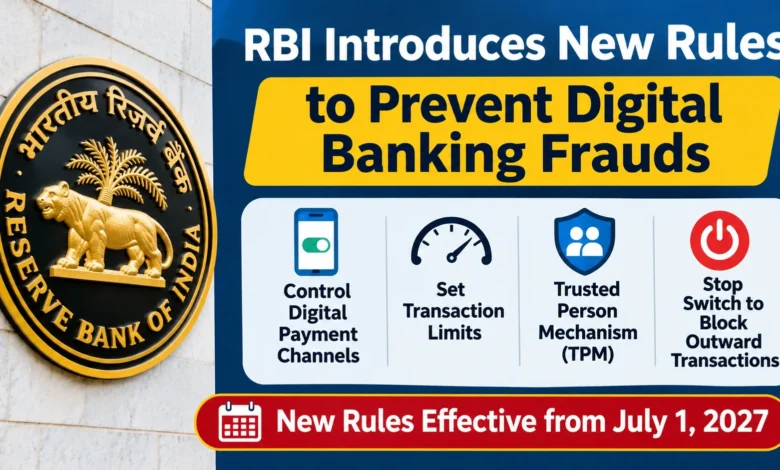
RBI Introduces New Rules to Prevent Digital Banking Frauds; Banks to Offer Stop Switch, Transaction Limits and Trusted Person Facility

| ➡️ Click here to Join Whatsapp News Group - Get instant updates of all Banking News |
The Reserve Bank of India (RBI) has introduced new measures to strengthen customer protection against fraudulent electronic banking transactions. Under the new rules, banks will have to provide customers with greater control over digital payment channels, transaction limits and account operations. The RBI has also introduced a Trusted Person Mechanism (TPM), under which customers can register a trusted person to provide an additional layer of authentication for certain high-value fund transfers.
The new provisions have been introduced through the Reserve Bank of India (Commercial Banks – Responsible Business Conduct) Fifth Amendment Directions, 2026. The amendments aim to prevent digital payment frauds by allowing customers to control how and when their banking channels can be used and by introducing additional verification for transactions exceeding customer-defined limits.
The RBI had earlier issued the Third Amendment Directions on June 24, 2026, to strengthen the rules relating to customer liability in fraudulent electronic banking transactions. However, after receiving public feedback on its Discussion Paper titled ‘Exploring Safeguards in Digital Payments to Curb Frauds’, dated April 9, 2026, the central bank decided to introduce additional preventive measures.
The new directions will apply to all commercial banks except Small Finance Banks, Payments Banks, Regional Rural Banks and Local Area Banks. The directions will come into effect from July 1, 2027, or an earlier date if a bank decides to implement them. However, certain provisions relating to the expanded definition of negligence by a bank will become effective from January 1, 2027.
1. Banks to Provide Customers with Control Over Digital Payment Channels
Under the new rules, banks will have to provide all customers with the facility to activate or deactivate one or more digital payment channels linked to their bank accounts. Customers will be able to disable a particular digital payment channel and enable it again whenever required through the bank’s physical or digital platforms.
Once a customer disables a digital payment channel, no customer-initiated debit transaction will be allowed through that channel until it is activated again.
For example, a customer who does not regularly use internet banking or mobile banking will be able to keep these channels disabled. If the customer needs to make an online transaction, the channel can be activated and disabled again after use.
2. Customers Can Set Their Own Transaction Limits
The RBI has directed banks to provide customers with additional options to control transaction limits through digital payment channels. Customers will be able to set or modify the maximum amount permitted per transaction, per beneficiary and for all transactions in a day through a particular channel.
For example, if a customer sets a limit of ₹20,000 per day for payments to a particular beneficiary, payments to that beneficiary cannot exceed ₹20,000, even if the bank or payment system allows a higher amount.
Similarly, if a customer sets a maximum transaction limit of ₹10,000 for a particular digital payment channel, any transaction above ₹10,000 will not be permitted through that channel.
Customers will also be able to set an overall daily transaction limit for a particular digital payment channel. For instance, if the customer sets a daily limit of ₹50,000, the total transactions through that channel cannot exceed this amount, even if the bank permits a higher limit.
Apart from these limits, customers will also be able to set an overall daily transaction limit covering all digital payment channels combined. Banks will also be allowed to introduce additional customer controls beyond these requirements to strengthen protection against fraudulent transactions.
3. Separate Transaction Controls for Debit Cards, Credit Cards and PPI Cards
The RBI has also introduced specific controls for debit cards, credit cards and prepaid payment instrument (PPI) cards.
Banks will have to provide cardholders with the facility to switch card transactions on or off and set or modify transaction limits within the overall card limit prescribed by the issuer.
These controls will cover different types of transactions, including domestic and international payments, Point of Sale (PoS) transactions, ATM withdrawals, online transactions and contactless payments.
However, these card-specific requirements will not apply to Gift PPI cards and Transit PPI cards.
4. Stop Switch Facility to Immediately Block All Outgoing Transactions
One of the important measures introduced by the RBI is the Stop Switch facility. Banks will have to provide customers with an option to immediately disable all future outward debit transactions associated with their bank accounts.
Once the Stop Switch is activated, customers will not be able to initiate debit transactions from their accounts. They will also not be able to create new payment mandates, set up new standing instructions or register their UPI accounts on new third-party payment applications.
However, certain transactions will remain outside the scope of the Stop Switch. These include existing recurring payment mandates and standing instructions, marking of liens and debits initiated by banks to recover outstanding charges, loan instalments and other dues.
Importantly, activating the Stop Switch will not affect incoming credits. Customers will continue to receive money in their accounts even when the facility is activated.
5. Re-activation of Digital Payment Channels and Stop Switch
The RBI has clarified that customers must be able to reactivate disabled digital payment channels or deactivate the Stop Switch whenever they want to resume normal banking operations.
However, banks will have to authenticate such requests in accordance with the RBI’s prescribed authentication requirements for digital payment transactions. The authentication process must be at least as stringent as the process followed when initially enabling the corresponding digital payment channel.
Banks may also introduce additional verification measures depending on their risk assessment. They may impose a reasonable cooling period or other risk mitigation measures before allowing the reactivation of a digital payment channel or deactivation of the Stop Switch.
6. Digital Payment Channels to Remain Disabled by Default for New Customers
The RBI has directed banks to keep all digital payment channels disabled by default when a new customer opens an account or completes the onboarding process.
Banks will be allowed to activate these channels only after obtaining the customer’s explicit consent and completing the applicable authentication requirements.
For cards, all newly issued physical and virtual cards must initially be enabled only for contact-based transactions within India, such as ATM withdrawals and payments through PoS devices. At the time of card re-issuance, the existing card controls must be transferred to the newly issued card.
However, forex prepaid cards must be enabled for both contact and contactless transactions outside India at the time of issuance or re-issuance.
For other digital payment channels, banks must specify an initial ceiling on the aggregate value of fund transfers that a customer can make during the first 24 hours after activation. This ceiling will be decided based on the bank’s risk assessment.
After the initial 24-hour period, banks may gradually increase the transaction ceiling based on their risk assessment and internal policies. Customers will be allowed to modify the initial or enhanced limits through the available customer controls, subject to authentication requirements. However, such modification will be permitted only after the initial 24-hour period following activation has expired.
7. Customer Controls Available Through Branches, ATMs and Mobile Banking
The RBI has directed banks to make facilities for activating, modifying and deactivating customer-induced controls and the Stop Switch available through all available customer service channels.
These facilities must be accessible through bank branches, ATMs, internet banking, mobile banking, Interactive Voice Response (IVR) and other available customer interfaces.
Whenever a customer activates, modifies, deactivates or reactivates any of these facilities, the bank must immediately send a notification through available communication channels, including SMS and email.
Banks must also maintain tamper-proof audit logs of customer-initiated controls and Stop Switch requests to help investigate disputes and resolve complaints.
In addition, banks will have to conduct regular awareness campaigns to educate customers about these facilities, the process of activation and deactivation, and the consequences of using these controls.
8. RBI Introduces Trusted Person Mechanism for Additional Transaction Authentication
Another major provision of the new directions is the introduction of the Trusted Person Mechanism (TPM).
Under this mechanism, customers will be able to register a trusted person aged 18 years or above to provide an additional layer of authentication for electronic fund transfers exceeding a transaction limit set by the customer.
The mechanism will apply to electronic fund transfers initiated through physical and digital banking channels, subject to the customer-defined threshold.
However, the Trusted Person Mechanism will not apply to payments made through the UPI channel linked to the customer’s account, merchant payments irrespective of the payment channel or instrument used, and recurring payments made through standing instructions, e-mandates or NACH mandates.
The facility will be voluntary. Banks will offer it to customers only when both the customer and the trusted person provide their explicit consent.
The facility will be available for individual bank accounts and eligible joint accounts operated under survivorship clauses.
9. How to Register a Trusted Person?
Banks will have to provide facilities for registering a trusted person, activating the mechanism and configuring transaction limits through both physical and digital channels.
For registration, banks will collect the trusted person’s name, mobile number, email address and a copy of at least one Officially Valid Document (OVD). Banks will verify the identity and eligibility of the trusted person using the OVD and other information or documents, wherever reasonably required.
The mobile number and email address of the trusted person must also be verified through an appropriate authentication process. Importantly, the mobile number registered for the trusted person must be different from the mobile number linked to the customer’s bank account.
Banks must clearly explain the role and limitations of a trusted person before completing the registration.
The RBI has clarified that registering as a trusted person will not make that individual a joint account holder, nominee, mandate holder or authorised signatory. The trusted person will not acquire any ownership rights or beneficial interest in the customer’s account.
The trusted person will also not be allowed to independently access or operate the account, initiate transactions or issue banking instructions. The trusted person will not have any financial liability for approving or rejecting a transaction.
After successful registration, banks must send an acknowledgement to both the customer and the trusted person. A 24-hour cooling period must be observed before activating the Trusted Person Mechanism. Once activated, both parties must be notified.
10. Trusted Person Must Approve Transactions Within One Hour
Under the new mechanism, whenever a customer initiates an electronic fund transfer exceeding the threshold set by them, the bank will send a notification to the registered trusted person for additional authentication.
The notification must contain important transaction details, including the transaction amount, beneficiary details such as name, account number and mobile number, and any narration entered by the customer while initiating the transaction.
The trusted person will get one hour from the time of receiving the notification to approve or reject the transaction through the authentication method prescribed by the bank.
The transaction will be executed only after the trusted person provides consent, subject to the bank’s fraud risk controls and other applicable requirements.
If the trusted person rejects the transaction or does not respond within the prescribed one-hour period, the transaction will be rejected.
Banks may obtain the trusted person’s approval through a physical or digital signature or any other authentication method permitted under the RBI’s Authentication Mechanisms for Digital Payment Transactions Directions, 2025. Banks must also maintain appropriate records and logs of the authentication process.
11. Trusted Person Will Not Have Access to Bank Account Details
The RBI has specifically clarified that the trusted person must not be given access to the customer’s banking relationship or confidential financial information.
The trusted person will not be allowed to view the customer’s account balance, fixed deposits, investments, insurance details or other banking information at any stage, including during transaction verification.
The role of the trusted person will remain strictly limited to providing additional authentication for transactions that exceed the customer’s specified threshold.
12. Customers Can Change Trusted Person or Opt Out of the Facility
Customers will have the option to change their registered trusted person, modify the transaction threshold, change the payment channels covered under the mechanism or completely opt out of the Trusted Person Mechanism.
However, any such change will be subject to customer authentication and a 24-hour cooling period.
If a bank assesses that a customer is particularly vulnerable to cyber-enabled financial frauds, it may introduce additional verification measures. These may include requiring the customer to visit a bank branch or undergo tele-verification before making changes.
Whenever a trusted person is changed or removed, the bank must notify both the customer and the outgoing trusted person before the change takes effect.
13. Banks Must Create Awareness About Trusted Person Mechanism
The RBI has directed banks to widely publicise the availability and benefits of the Trusted Person Mechanism.
Banks must educate customers about the applicability, features, benefits and limitations of the facility and clearly explain the role of the trusted person.
Such information must be communicated in English, Hindi and the local language of the concerned region. Banks may use branches, SMS, email and other available customer communication channels for this purpose.
14. RBI Expands Definition of Negligence by Banks in Digital Banking Frauds
The RBI has also expanded the definition of ‘negligence by a bank’ under its existing directions on customer protection in fraudulent electronic banking transactions.
Under the revised definition, negligence by a bank will include any act of omission or commission by the bank that results in or contributes to a fraudulent electronic banking transaction in a customer’s account.
The revised definition specifically covers ten situations.
First, if a bank fails to implement the prescribed authentication requirements for electronic banking transactions, it may be treated as negligence.
Second, failure to implement multi-factor authentication when creating new account linkages, adding, modifying or deleting beneficiaries, changing account details or revising fund transfer limits will also fall under this definition.
Third, failure to send mandatory transaction alerts to customers will be considered negligence.
Fourth, banks must provide 24×7 channels for reporting fraudulent electronic banking transactions and loss of debit or credit cards. Failure to provide these facilities will fall under the revised definition.
Fifth, if a bank does not act promptly after receiving a customer’s complaint about a fraudulent electronic banking transaction or loss of a debit or credit card, it may be considered negligent.
Sixth, failure to block a digital payment channel or notify the customer after the maximum number of failed login or authentication attempts, where such failure contributes to fraud, will also be covered.
Seventh, if a bank fails to provide mandatory customer-induced controls or does not implement the controls selected by the customer, it may be treated as negligence.
Eighth, failure to provide the Trusted Person Mechanism or comply with the requirements governing this facility will also be covered.
Ninth, any system malfunction or security breach at the bank’s end that facilitates or results in a fraudulent electronic banking transaction will be treated as negligence.
Tenth, collusion or connivance by a bank employee or any third party engaged by the bank, which facilitates or results in a fraudulent electronic banking transaction, will also fall under the revised definition.
This expanded definition is intended to ensure that banks remain accountable for security failures, inadequate safeguards and delays in responding to fraud complaints.
15. Effective Date of the New RBI Directions
The Reserve Bank of India (Commercial Banks – Responsible Business Conduct) Fifth Amendment Directions, 2026, have been issued under Section 35A of the Banking Regulation Act, 1949.
The directions will apply to commercial banks other than Small Finance Banks, Payments Banks, Regional Rural Banks and Local Area Banks.
The general effective date will be July 1, 2027, or an earlier date if a bank decides to implement the provisions.
However, the provisions relating to clauses (i) to (vi), (ix) and (x) of the expanded definition of ‘negligence by a bank’ will come into effect earlier, from January 1, 2027.
Click here to download RBI Circular
Also Check This

Please login to comment