| ➡️ Click here to Join Whatsapp News Group - Get instant updates of all Banking News |
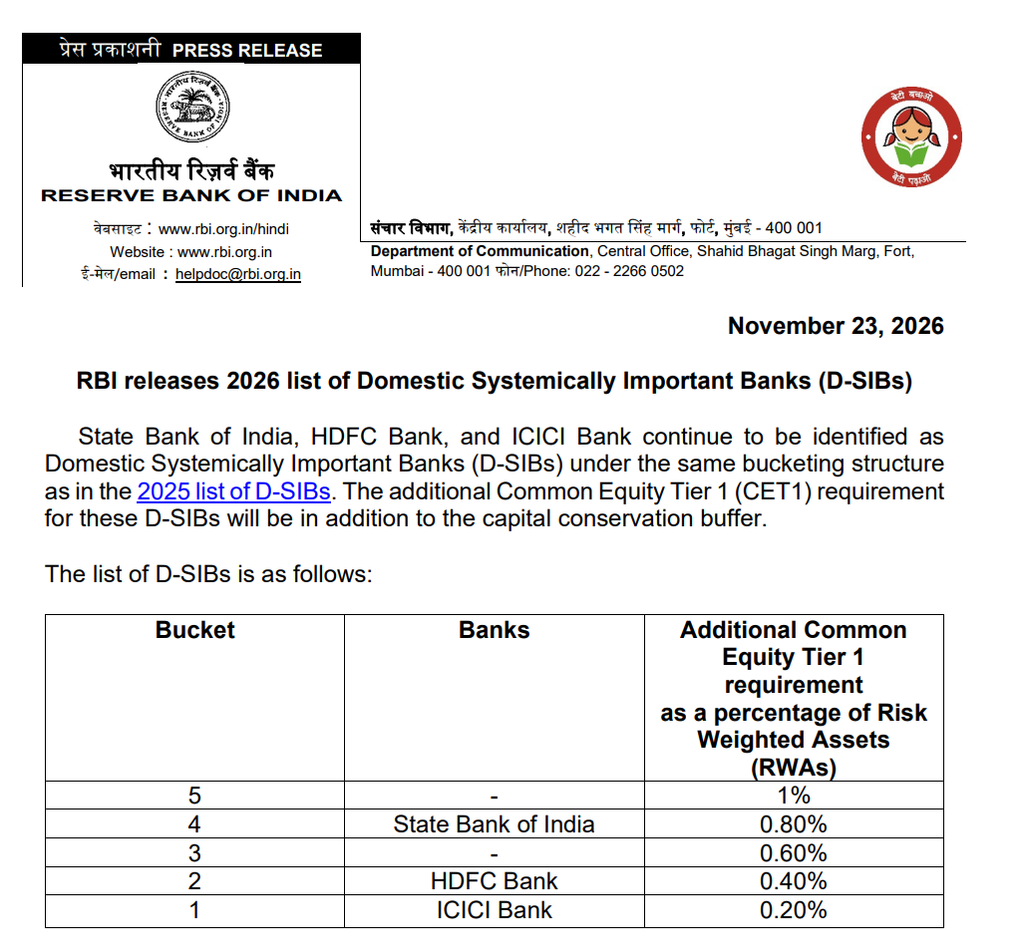
The Reserve Bank of India (RBI) has released 2026 list of Domestic Systemically Important Banks (D-SIBs). State Bank of India, HDFC Bank, and ICICI Bank continue to be identified as Domestic Systemically Important Banks (D-SIBs) under the same bucketing structure as in the 2025 list of D-SIBs. The additional Common Equity Tier 1 (CET1) requirement for these D-SIBs will be in addition to the capital conservation buffer.
The list of D-SIBs is as follows:
| Bucket | Banks | Additional Common Equity Tier 1 requirement as a percentage of Risk Weighted Assets (RWAs) |
|---|---|---|
| 5 | – | 1% |
| 4 | State Bank of India | 0.80% |
| 3 | – | 0.60% |
| 2 | HDFC Bank | 0.40% |
| 1 | ICICI Bank | 0.20% |
The D-SIB framework requires the Reserve Bank to disclose the names of banks designated as D-SIBs starting from 2015 and place these banks in appropriate buckets depending upon their Systemic Importance Scores (SISs). Based on the bucket in which a D-SIB is placed, an additional common equity requirement has to be applied to it. In case a foreign bank having branch presence in India is a Global Systemically Important Bank (G-SIB), it has to maintain additional CET1 capital surcharge in India as applicable to it as a G-SIB, proportionate to its Risk Weighted Assets (RWAs) in India, i.e., additional CET1 buffer prescribed by the home regulator (amount) multiplied by India RWA as per consolidated global Group books divided by total consolidated global Group RWA. The Reserve Bank had announced SBI and ICICI Bank as D-SIBs in 2015 and 2016 while HDFC Bank was classified as D-SIB in 2017 along with SBI and ICICI Bank. The current update is based on the data collected from banks as on March 31, 2026.
Why Banks need to maintain Additional Common Equity Tier 1 (CET1)?
The Additional Common Equity Tier 1 (CET1) requirement as a percentage of Risk Weighted Assets (RWAs) means that a bank identified as a Domestic Systemically Important Bank (D-SIB) must maintain an additional amount of high-quality capital, depending on its systemic importance.
In simple terms, RBI requires SBI, HDFC Bank and ICICI Bank to maintain extra capital as a safety cushion so that they can absorb financial losses during an economic or banking crisis.
Let’s understand this with an example.
1. What are Risk Weighted Assets (RWAs)?
Banks give different types of loans and make investments. However, all assets do not carry the same level of risk.
For example:
- Home loans may carry relatively lower risk weights.
- Personal loans may carry higher risk weights.
- Some government securities may carry very low or zero risk weights.
RBI assigns risk weights to different assets. The total value of assets after applying these risk weights is called Risk Weighted Assets (RWAs).
2. What does additional CET1 requirement mean?
Suppose SBI has Risk Weighted Assets of ₹10 lakh crore. Under the D-SIB framework, SBI falls under Bucket 4 and must maintain an additional CET1 capital of 0.80%.
Calculation: Rs.10,00,000 crore x 0.80% = Rs.8000 crore
This means SBI must maintain an additional ₹8,000 crore of qualifying CET1 capital against ₹10 lakh crore of RWAs.
3. Additional CET1 requirement for D-SIBs in 2026
| Bank | Bucket | Additional CET1 requirement |
|---|---|---|
| State Bank of India | 4 | 0.80% |
| HDFC Bank | 2 | 0.40% |
| ICICI Bank | 1 | 0.20% |
For example, if all three banks have RWAs of ₹10 lakh crore:
| Bank | Additional capital required |
|---|---|
| SBI | ₹8,000 crore |
| HDFC Bank | ₹4,000 crore |
| ICICI Bank | ₹2,000 crore |
These are illustrative calculations, not the banks’ actual capital requirements.
4. What is the purpose of this requirement?
The purpose is to ensure that large banks have sufficient capital to withstand unexpected financial losses. If a systemically important bank faces serious financial difficulties, its failure could affect the entire banking system and economy. Therefore, RBI requires these banks to maintain additional capital to:
- Absorb unexpected financial losses.
- Protect depositors and maintain confidence in the banking system.
- Reduce the possibility of bank failure.
- Minimise the impact of a major bank’s financial crisis on the economy.
5. Is this requirement over and above the Capital Conservation Buffer?
Yes. The additional CET1 requirement under the D-SIB framework is over and above the Capital Conservation Buffer (CCB).
For example, if a bank is required to maintain a particular CET1 capital level under general regulatory norms, it must maintain an additional D-SIB surcharge depending on its bucket.
In simple words: SBI has to maintain a higher additional capital cushion than HDFC Bank and ICICI Bank because it is placed in a higher systemic importance bucket. This does not mean SBI has to deposit this money with RBI. It means the bank must maintain the required amount as qualifying regulatory capital on its balance sheet.
Also Check This



Please login to comment