| ➡️ Click here to Join Whatsapp News Group - Get instant updates of all Banking News |
US President Donald Trump has cited India’s economic growth and relatively low interest rates to criticise the US Federal Reserve (Fed) for keeping borrowing costs high. He said the US economy could achieve growth of 15% to 20% if the central bank reduced interest rates.
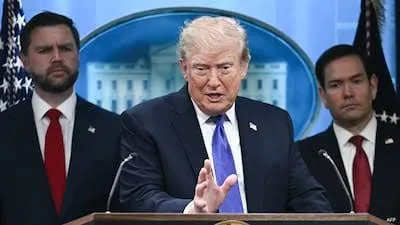
Trump made these remarks while speaking to reporters at the White House on Friday, November 20, 2026. He accused the US Federal Reserve of following a political approach to monetary policy and said it was raising interest rates even when the country reported strong economic figures.
Trump Praises India’s Economic Growth
Referring to India’s economic performance, Trump said the country was recording around 7% GDP growth despite having relatively low interest rates. He argued that the US could achieve much higher economic growth if the Federal Reserve followed a similar approach and reduced borrowing costs.
“If you look at India, they have low interest rates, and they have a 7 per cent GDP. We’d have a 14%, 15%, maybe even a 20% GDP,” Trump said.
Advertisement
He also questioned why the US should not have the lowest interest rates in the world, considering its economic strength and role in supporting other countries.
Trump Accuses US Federal Reserve of Being Political
Trump criticised the US Federal Reserve for increasing interest rates despite strong economic performance. He said that when economic figures improve, the central bank should consider lowering interest rates instead of increasing them.
“Interest rates are too high because we have a very political Fed,” Trump said.
Advertisement
He further argued that stronger economic performance should make the US a more creditworthy borrower, allowing it to access loans at lower interest rates. Trump also claimed that lower borrowing costs could help the US achieve faster economic growth and repay its national debt more quickly.
- Criticism of the Fed: Speaking at the White House, Trump called the Federal Reserve “very political” and claimed it raises rates when strong economic data is released, arguing rates should instead fall to reflect stronger creditworthiness.
- Growth Projections: Trump claimed the US could achieve 14% to 20% GDP growth—and pay down debt faster—if interest rates were lowered.
- Comparison with India: Pointing to India’s 7% growth and Reserve Bank of India (RBI) interest rate policy, Trump argued the US should have some of the lowest interest rates globally.
Why Does the US Federal Reserve Keep Interest Rates High?
The US Federal Reserve considers inflation and employment conditions while deciding monetary policy. Its main objectives include maintaining price stability and supporting maximum employment.
When inflation remains high, the central bank may increase interest rates to make borrowing more expensive. This can reduce spending and investment demand and help control inflation. The US Federal Reserve has maintained that controlling inflation remains important, even when economic growth is strong.
US and India Interest Rate Comparison
| Particulars | India | USA |
|---|---|---|
| Central bank | RBI | Federal Reserve |
| Policy rate | 5.50% | 3.75%–4.00% |
One more important point: Interest rates cannot be compared in isolation. Inflation, economic growth, currency stability and borrowing conditions also influence central bank decisions. In fact, Reuters reported on November 20 that economists expected RBI to raise the repo rate further because inflation had crossed its 6% upper target limit.
The U.S. Federal Reserve’s federal funds target range is 3.75%–4.00%, held steady at its October 28, 2026 meeting following a 25-basis-point hike in September 2026.
Key Rates (as of November 19, 2026)
- Effective Federal Funds Rate: 3.88%
- Bank Prime Loan Rate: 7.00%
- Discount Window Primary Credit: 4.00%
- U.S. Treasury Bills (Secondary Market):
- 4-week: 4.05%
- 3-month: 4.16%
- 6-month: 4.31%
In the United States, a bank prime loan refers to lending priced off—or offered to borrowers qualifying for—the prime rate, the benchmark interest rate commercial banks charge their most creditworthy customers. The Federal Reserve also uses “bank prime loan” on its statistical releases to report the prime rate posted by major U.S. banks.
Major U.S. banks typically set their prime rate about 3 percentage points (300 basis points) above the top of the Federal Reserve’s federal funds target range.
Also Check This


Please login to comment