| ➡️ Click here to Join Whatsapp News Group - Get instant updates of all Banking News |
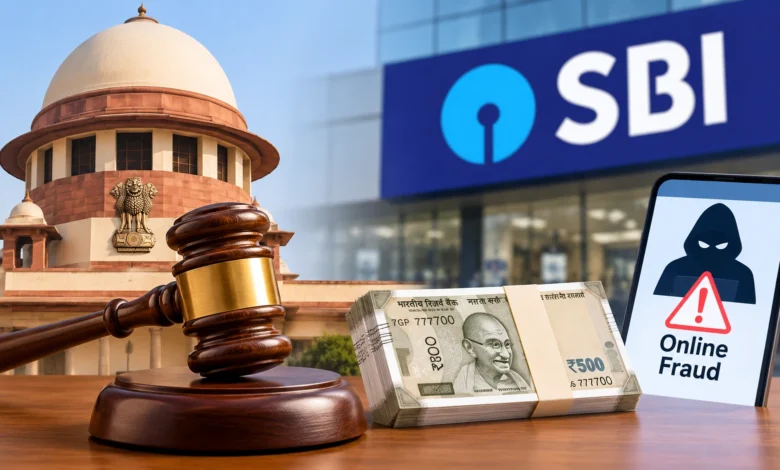
A Delhi consumer commission has directed the State Bank of India (SBI) to refund ₹35,010 to an advocate who lost money in two unauthorised transactions after being tricked into downloading a fraudulent application in the name of updating his mobile connection’s KYC. The commission also ordered the bank to pay ₹15,000 as compensation for mental harassment and litigation expenses, taking the total amount payable to ₹50,010.
The commission rejected SBI’s argument that the transactions had been authenticated through one-time passwords (OTPs) sent to the customer’s registered mobile number. It noted that the advocate had not shared the OTP and had promptly reported the unauthorised transactions. The complaint was heard on October 14 by a bench comprising President Divya Jyoti Jaipuriar and members Ashwani Kumar Mehta and Harpreet Kaur Charya.
The advocate maintained a savings account at SBI’s Tis Hazari Court branch in Delhi. According to his complaint, on September 8, 2021, he received a message stating that his KYC had expired. He then received a phone call from the same number. The caller asked him to download an application from the Play Store, enter the required details and pay ₹10 to update his KYC.
Also Read: FM Sitharaman replies to Rahul Gandhi’s Letter related to IDBI Bank Privatisation
Believing the caller’s claims, the advocate downloaded the application and made the payment. He subsequently received an OTP for a transaction of ₹35,000. He stated that he had not authorised the transaction and had not shared the OTP with anyone. Suspecting fraud, he immediately uninstalled the application, disconnected his internet connection and contacted SBI’s toll-free helpline.
The advocate said he was informed that ₹10 and ₹35,000 had been debited from his account. He immediately requested the bank to stop the payment, reported the transactions and blocked his debit card and UPI services to prevent further losses.
Although bank officials initially assured him that the money would be refunded, SBI rejected his claim in January 2022. The bank maintained that both transactions had been authenticated through OTPs and argued that the customer had downloaded a third-party application himself. The advocate then approached the consumer commission seeking a refund and compensation.
Also Read: Orissa High Court Directs Odisha Grameen Bank to Frame Regularisation Scheme for Temporary Employees
While examining the complaint, the commission found that the ₹35,000 transaction was recorded at 7:40 pm on September 8, 2021, after the customer had blocked his debit card and disabled UPI services. It observed that once the bank was informed about an unauthorised transaction, it was responsible for taking appropriate steps to stop it.
The commission noted that customers who share their payment credentials may be liable for losses incurred before they report an unauthorised transaction. However, in this case, it found no evidence that the advocate had shared his OTP or other payment credentials. It also observed that downloading a fraudulent application does not, by itself, establish negligence on the customer’s part.
Also Read: Delhi Consumer Commission Orders Union Bank to Pay Rs 47 Lakh for Missing Jewellery from Bank Locker
The commission further pointed out that SBI had failed to resolve the complaint within the prescribed 90-day period. After considering the facts and the bank’s response, it directed SBI to refund ₹35,010 for the two unauthorised transactions and pay an additional ₹15,000 as compensation for mental harassment and litigation expenses.
The case highlights the importance of reporting suspected banking fraud immediately. Customers should never share OTPs or banking credentials with unknown callers. If they notice an unauthorised transaction, they should promptly contact their bank, block the affected payment instruments and register a formal complaint.
Also Read: PNB Issues Advisory to Staff on Unauthorized Access to Bank Systems
Also Check This


Please login to comment