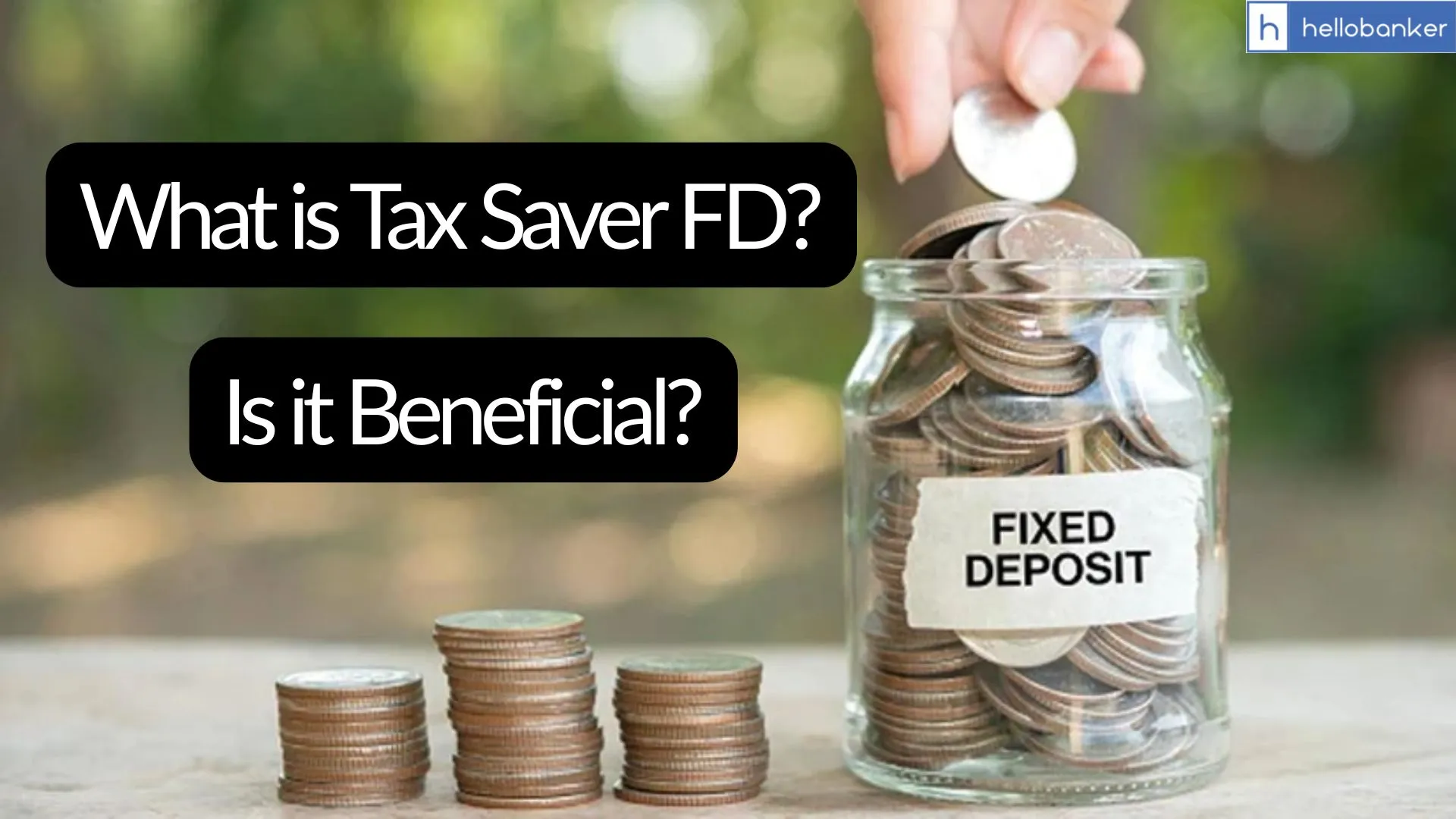
While creating an FD, you must surely have come across Tax Saver FD. You must have thought whether Tax Saver FD is Good or not? It really saves Tax or not and is it beneficial or not? Today, in this article, we will know all about Tax Saver FD.
Tax Saving Fixed Deposits (FD) are special saving schemes that help individuals save on taxes while earning interest. You invest your money in FD and save Tax. Under Section 80C of the Income Tax Act, 1961, investors can claim a tax deduction of up to ₹ 1.5 lakh per year by investing in these FDs. However, Tax Saving FDs come with a lock-in period of 5 years, meaning you can’t withdraw the invested amount during this time. The interest rate for tax saving FDs varies from bank to bank and the interest earned on this is considered as taxable income.
Some key features of a Tax Saving FD are:
- A Tax Saving FD lets you avail Income Tax exemption under Section 80C of the Income Tax Act, 1961. The Fixed Deposit Income Tax exemption can be claimed on investments of up to ₹ 1.5 lakh
- The lock-in period is five years
- The interest earned, as a part of the Tax Saving Fixed Deposit is taxable and is deducted at source
- Premature withdrawals, Loans or Overdraft (OD) facilities are not available for a Tax Saving FD. Regular Fixed Deposits offer Loan against deposits
- There is no auto-renewal facility for Tax Saving Fixed Deposits
- Interest payouts are flexible; you can opt for monthly or quarterly payouts or reinvest in principal
- Tax Saving FD interest rates remain unchanged over the five-year period
- Interest rates differ from bank to bank and rates for Indian citizens, Hindu Undivided Family (HUF) also vary
- Tax Saving FDs can be held in a single or a joint mode. If it’s a joint Tax Saving Fixed Deposit, tax benefits are available only to the first account holder.
Advantages of Tax Saving Fixed Deposits compared to other Section 80C investments
The two most common options for claiming income tax exemption under Section 80C include Equity Linked Savings Scheme (ELSS) and Public Provident Fund (PPF). The main advantage that a Tax Saving FD has over ELSS is that it is not market-linked. While ELSS has a lower lock-in period of three years, the minimum investment required is ₹ 500. Also, ELSS comes with some amount of risk as it is market-linked. The minimum investment required in a Tax Saving Fixed Deposit is ₹ 10,000. While you can open a PPF Account with an opening balance of ₹ 500, the minimum investment has to be ₹ 500. Also, a PPF comes with a lock-in period of 15 years.
Are Tax Saving FD Good? Should You Invest Money?
Yes — tax-saver FDs can be a good option especially for someone who values safety, is looking for tax deduction under 80C, and can commit for 5 years. But they are not the best option in all cases. If you are comfortable with some risk, or require liquidity, or aim for higher after-tax returns, you should compare with other options (like PPF, ELSS, etc.). Tax Saving FD is beneficial for you or not, depends on various factors. It depends on your financial goals, risk appetite, tax bracket, and liquidity needs. Before investing, ask these questions to yourself:
- Are you okay with using up your Section 80C deduction limit in this option (versus splitting across multiple tax-saving instruments)?
- Are you in a high tax bracket and looking to reduce taxable income this year? If yes, then the deduction benefit helps.
- Can you lock away the money for 5 years without needing it for emergencies or other goals? If yes, the lock-in is acceptable; if no, this may be too restrictive.
- Is your priority capital safety and predictability rather than maximum returns? If yes, then tax-saver FD makes sense; if you are comfortable with risk and seek higher returns, you might explore tax-efficient options like equity-linked savings funds (ELSS) etc.
- Have you checked after-tax return? For you, what matters is not just the nominal interest, but what you get after tax. If you’re in the highest tax slab, the effective yield might drop significantly.
Comparison of Tax Saving FD with other investment options
| Feature | 🏦 Tax-Saver FD | 🏛️ PPF (Public Provident Fund) | 📈 ELSS (Equity-Linked Savings Scheme) | 📜 NSC (National Savings Certificate) |
|---|---|---|---|---|
| Lock-in Period | 5 years | 15 years (partial withdrawal from 7th year) | 3 years | 5 years |
| Returns (approx.) | 6% – 7% (fixed by bank) | 7.1% (set by govt., quarterly) | 10% – 15% (market-linked) | 7.7% (fixed by govt.) |
| Risk Level | Very Low | Very Low | Moderate to High | Very Low |
| Tax Deduction (80C) | ✅ Up to ₹ 1.5 lakh | ✅ Up to ₹ 1.5 lakh | ✅ Up to ₹ 1.5 lakh | ✅ Up to ₹ 1.5 lakh |
| Tax on Returns | Interest taxable | Interest tax-free | LTCG tax @ 10% (above ₹ 1 lakh) | Interest taxable |
| Liquidity | Locked for 5 yrs | Very low (15 yrs total) | Can redeem after 3 yrs | Locked for 5 yrs |
| Loan / Partial Withdrawal | ❌ Not allowed during lock-in | ✅ Loan after 3 yrs | ❌ Not allowed | ✅ Loan allowed |
| Best For | Safe investors seeking short-term tax savings | Long-term, low-risk savers | Growth-oriented, equity investors | Conservative savers |
| Ideal For | Salaried individuals wanting guaranteed returns | Retirement & long-term planning | Younger investors comfortable with volatility | Moderate investors wanting fixed income |
Understand with help of an Example
| Option | Average Return (p.a.) | After-Tax Value (for 30% slab) | Remarks |
|---|---|---|---|
| Tax Saver FD | 6.5% | ₹1.86 L (interest taxed) | Safe, but low effective yield (~4.9%) |
| PPF | 7.1% | ₹2.13 L (tax-free) | Best tax-adjusted return |
| ELSS | 12% | ₹2.65 L (after 10% LTCG) | Highest potential growth |
| NSC | 7.7% | ₹2.18 L (interest taxed) | Secure, but taxable income |
So, now you can decide whether to invest in Tax Saving FD or not. If you have any doubts, you can ask in comment section below.
-
-

-

-

-

-

-

-
-

-

-

-