| ➡️ Click here to Join Whatsapp News Group - Get instant updates of all Banking News |
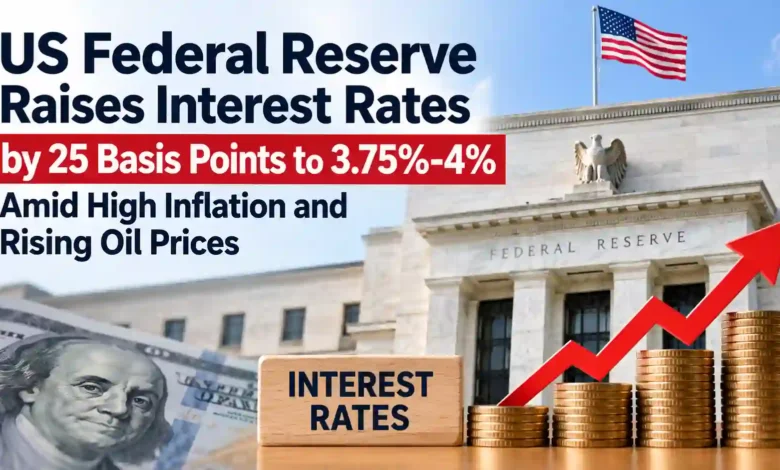
The United States Federal Reserve has decided to increase interest rates by 25 basis points as inflation continues to remain high. Rising fuel prices linked to the ongoing US-Iran conflict have added further pressure on the US economy.
The Federal Reserve, which is the central bank of the United States, announced on Wednesday that it would raise its key interest rate by 0.25 percentage points to a range of 3.75% to 4%.
First Rate Hike in More Than Three Years
This is the first interest rate increase by the Federal Reserve in more than three years. The decision comes only weeks before the US midterm elections and despite repeated calls from President Donald Trump for lower interest rates.
The Fed said that economic activity in the US is continuing to grow at a solid pace. It also said that domestic spending has remained strong, although uncertainty has increased because of geopolitical developments.
The central bank said inflation is still above its target and that the latest rate increase is aimed at helping inflation return to its 2% goal.
Fed Expects Another Rate Increase
According to the Federal Reserve’s quarterly projections, officials expect one more interest rate increase this year. After that, they expect interest rates to remain unchanged through next year.
The CME FedWatch tool, which tracks expectations about Federal Reserve decisions, had estimated a 92.3% chance of a 25-basis-point rate increase. Just one week earlier, the probability had been around 40%.
US Inflation Remains High
Several economic reports changed expectations about the Fed’s decision. Consumer prices in the US increased by 0.4% in August, marking the biggest monthly increase in four months. On a yearly basis, consumer prices increased by 3.4% in August, the same annual increase recorded in July.
Higher prices have also been linked to factors such as US tariffs and increased investment related to the rapid growth of the artificial intelligence industry. At the same time, the US job market has remained relatively strong.
Rising Oil Prices Add to Inflation Pressure
Oil prices have also increased sharply. Benchmark Brent crude was trading close to $109 per barrel on Tuesday as fighting connected to the US-Israel conflict with Iran intensified.
Higher oil prices can increase the cost of transportation, manufacturing and other goods and services. This can put additional pressure on inflation.
Petrol and Diesel Prices Rise
According to the American Automobile Association (AAA), the average price of petrol in the US reached $4.36 per gallon, or around $1.15 per litre. This was an increase of 14 cents over the previous week and up from $4.06 per gallon, or around $1.07 per litre, a month earlier.
Diesel prices were even higher, reaching an average of $6.31 per gallon, or about $1.67 per litre. This was the highest average price recorded and was roughly twice the level seen a year earlier.
Higher diesel prices can affect the prices of many products because diesel is widely used by trucks to transport goods such as fruits, vegetables, steel and cement.
10-Year Treasury Yield Crosses 5%
The benchmark 10-year US Treasury yield also moved above 5% on Tuesday. It reached 5.02%, its highest level in 19 years.
The 10-year Treasury yield is important because it influences borrowing costs across the economy, including home mortgages and car loans. It is also closely watched as an indicator of inflation and economic expectations.
Economists See a Difficult Situation
Michael Klein, a professor of international economic affairs at Tufts University’s Fletcher School and executive editor of EconoFact, said the US economy is currently in an unusual situation.
Unemployment remains at a comfortable level, while prices continue to remain high. This has kept inflation above the Federal Reserve’s 2% target.
Klein also said there had been pressure on Fed Chair Kevin Warsh to increase interest rates because inflation was higher than expected. He also pointed to concerns about President Trump’s repeated demands for lower interest rates.
Trump Calls for Lower Interest Rates
President Donald Trump continued to argue that US interest rates should be much lower. Nearly three hours after the Federal Reserve announced its decision, Trump posted on Truth Social that US interest rates should be 1% or lower. He argued that the US economy is receiving strong investment and again called for interest rates to be reduced quickly.
Later on Wednesday, Trump said he still had confidence in Fed Chair Kevin Warsh. However, he also said that interest rates were too high and that they were not appropriate for the US economy.
Trump Previously Criticised Jerome Powell
Trump had also repeatedly criticised former Federal Reserve Chair Jerome Powell for not lowering interest rates.
The US government had even launched a criminal investigation involving Powell. Powell had previously described such actions as “pretexts” intended to weaken the independence of the Federal Reserve.
What the Rate Hike Means
The Federal Reserve’s rate increase is mainly aimed at controlling inflation. Higher interest rates generally make borrowing more expensive, which can reduce spending and investment and eventually help slow price increases.
However, higher rates can also increase the cost of loans for consumers and businesses. This means that the Fed has to balance the need to control inflation with the need to support economic growth.