
Tax on Disability Pension: The government’s decision to impose income tax on a section of disability pensions for armed forces personnel has sparked strong public criticism. Many veterans and opposition leaders have called the move unfair and discriminatory.
For more than 100 years, certain retired armed forces personnel have been receiving disability pensions that were fully exempt from income tax. This exemption has been in place since 1922 under the old Income Tax Act. However, the Union Budget 2026 has proposed a major change.
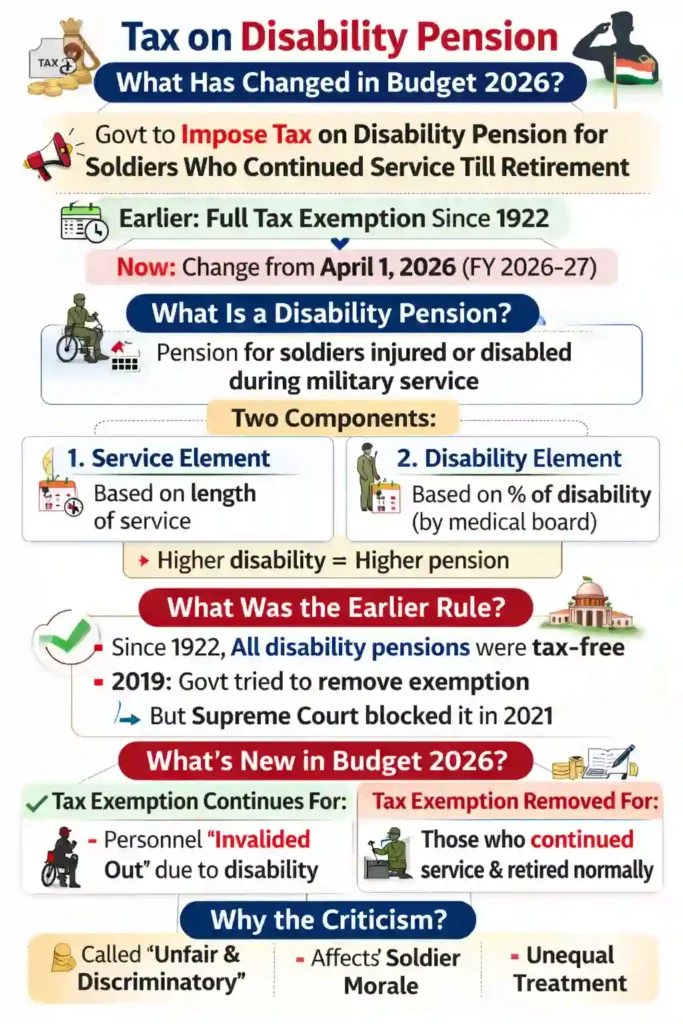
What Is a Disability Pension?
A disability pension is given to armed forces personnel who suffer injuries or disabilities during military service. This may include disabilities caused directly by duty or those that were aggravated because of service conditions.
The disability pension usually has two components:
- Service Element – This is based on the length of service.
- Disability Element – This is based on the percentage of disability determined by a medical board.
The higher the disability percentage, the higher the disability element. This system ensures that personnel with more severe disabilities receive greater financial support.
Govt has imposed Tax on Disability Pension. Under the Union Budget 2026, only defence personnel ‘invalidated’ out of service on account of disability will retain the exemption. Those who continue their service will not. pic.twitter.com/5fuy8AejgS
— Hellobanker (@Hellobanker_in) February 17, 2026
What Was the Earlier Rule?
Since 1922, disability pensions for armed forces personnel have been fully exempt from income tax.
In 2019, the Income Tax Department issued a circular attempting to withdraw this exemption for personnel who were not “invalided out” of service — meaning those who continued working despite their disability.
However, in 2021, the Supreme Court stayed this circular. The Court held that such a long-standing practice could not be changed by just issuing a departmental circular. As a result, the tax exemption continued.
Also Read: 5 Day Banking: Bharatiya Mazdoor Sangh will observe 25 February as Protest Day
What Has Changed in the 2026 Union Budget?
In the Union Budget presented on February 1, 2026, and through the Finance Bill 2026, the government has proposed to amend the Income Tax Act.
Under the new proposal:
- Full tax exemption will continue only for personnel who were invalided out of service due to bodily disability that was caused by or aggravated during military duty.
- Personnel who suffered disability but continued serving until normal retirement (superannuation) or took premature retirement will no longer receive full tax exemption.
- This change will apply from April 1, 2026 (tax year 2026–27 onward).
What Does This Mean in Simple Terms?
If a soldier had to leave service because of disability, their disability pension will remain tax-free. But if a soldier continued serving despite disability and retired later after completing service normally, their disability pension will now be taxable. This distinction has become the main point of controversy.
Why Are Veterans Calling It Discriminatory?
Affected veterans argue that:
- Both categories of soldiers suffered disability during service.
- The injury or disability does not become less serious just because a soldier continued working.
- Taxing one category while exempting the other creates unequal treatment.
They describe the decision as “discriminatory and arbitrary.”
Also Read: Prosecution Proposal filed Against ICICI Bank MD & CEO
Political Reaction
The Congress party, on February 18, 2026, criticised the move strongly. The party called it an “insult” to the sacrifice of soldiers and warned that such a step could negatively affect the morale of armed forces personnel.
The Larger Debate
Supporters of the exemption argue that disability pensions are compensation for injuries sustained while protecting the country and should not be taxed under any circumstances. The government, however, appears to be trying to limit the exemption only to those who were forced to leave service due to disability. As the amendment is set to take effect from April 2026, the debate over fairness, morale, and recognition of military service continues.
Also Read: PNB rejected Compassionate Appointment, Allahabad High Court orders in favour of Petitioner