SBI decides to Terminate Lease of GMU in Kolkata, Fear of Job and Revenue Loss in West Bengal

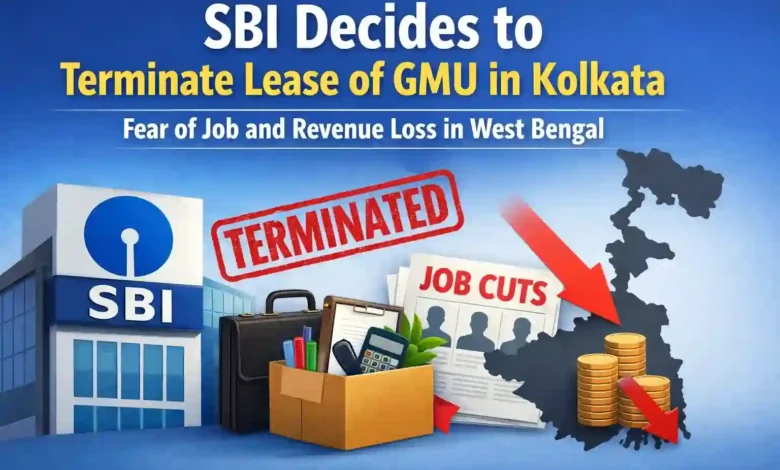
SBI’s plan to shut its Global Markets Unit in Kolkata has sparked strong opposition, with civil society groups asking the RBI to step in.
India’s largest bank, State Bank of India, has decided to terminate the lease of its Global Markets Unit (GMU) premises in central Kolkata. The move has raised concerns about job losses, loss of revenue for West Bengal, and the gradual shifting of key banking operations out of the city.
The Global Market Unit (GMU) is a major division of SBI that handles high-value financial operations like foreign exchange and global finance. This unit has been operating from Kolkata for years and contributes significantly to the state’s revenue through GST payments.
According to an SBI notice dated January 14, 2026, the bank has informed a vendor that it is ending the lease for the 11th to 16th floors of the Jeevan Sudha Building on Jawaharlal Nehru Road. This office currently houses the GMU, which handles important work such as:
- Foreign exchange operations
- Treasury functions
- Remittances
- Global back-office activities
The notice gives one month to vacate, clearly pointing to SBI’s plan to shift these operations to Mumbai.
Impact on jobs and revenue
The GMU employs around 132 permanent staff, including officers and clerks. When contractual workers are included, nearly 300 people depend on this unit for their livelihood.
While permanent employees are expected to be relocated, sources say contractual workers may lose their jobs. This has added to the anxiety around the proposed closure. SBI is India’s largest public sector Bank and a lot of people are indirectly dependant on SBI for their livelihood.
The unit is also estimated to contribute about ₹25 crore annually in GST, a loss that could directly impact the state’s revenue.
Civil society moves RBI
Opposing the decision, the civil society forum Bank Bachao Desh Bachao Manch (BBDBM) has written to the Reserve Bank of India governor, urging immediate regulatory intervention.
In their letter, joint convenors Biswaranjan Ray and Soumya Datta stated that SBI has already informed Life Insurance Corporation of India of its plan to vacate the building by March 31, 2026. According to the forum, this shows that the shutdown of the GMU in Kolkata is already being implemented.
The forum has strongly requested the RBI not to allow SBI to surrender the licence required to operate the GMU in the city.
In March 2025, the group wrote to the President of India complaining about the proposed relocation. In response, SBI’s Deputy General Manager (Operations) from the Corporate Centre sent a letter on June 11, 2025, explaining that such decisions are a part of SBI’s routine business operations based on changing operational and administrative needs.
A long-term shift away from Kolkata?
BBDBM also pointed out that this is not an isolated move. Over the years, SBI has gradually shifted several important functions out of Kolkata, including:
- Income tax-related work
- Balance sheet preparation
- Central accounts operations
Most of these functions were moved to Mumbai, reducing Kolkata’s role in specialised banking operations.
Why this matters
The proposed closure of the GMU could:
- Weaken specialised banking expertise in the region
- Lead to job losses, especially among contractual staff
- Reduce Kolkata’s financial importance
- Cause a direct revenue loss to the state
As pressure mounts, all eyes are now on the RBI and whether it will intervene to stop or review SBI’s decision.