PNB parks interest in Suspense Account for NPA Accounts, Supreme Court orders Trust to pay full amount

| ➡️ Click here to Join Whatsapp News Group - Get instant updates of all Banking News |
The Supreme Court of India has ruled in favor of Punjab National Bank (PNB) in a long-running loan recovery dispute against a charitable trust.
The judgment, delivered by a bench comprising Justice Sanjay Kumar and Justice Sanjeev Sachdeva, set aside an earlier decision by the Orissa High Court that had allowed the trust to settle its massive debt for a heavily reduced amount.
The Background
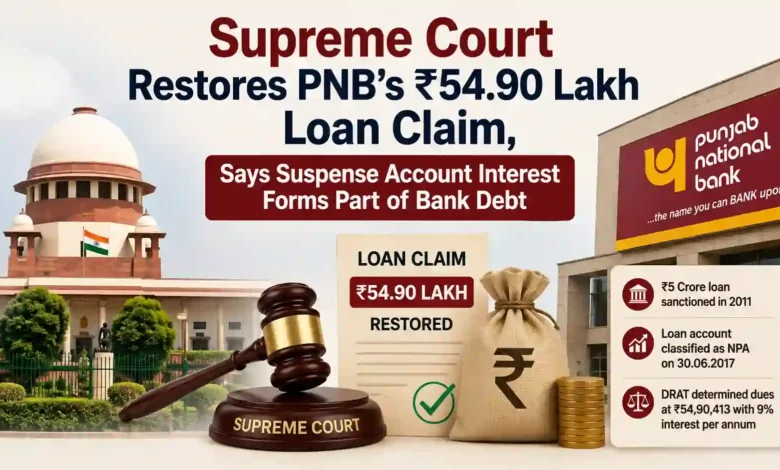
The case dates back to June 2011, when the United Bank of India (which later merged into PNB in 2020) sanctioned a ₹5 crore loan to M/s. Shree Jyoti Education and Management Trust World to construct a college building. The trust’s managing trustee, Tara Prasad Satpathy, along with other trustees, stood as guarantors.
The loan account was eventually classified as a Non-Performing Asset (NPA) in June 2017 after the trust failed to keep up with payments. The bank then initiated recovery proceedings through the Debts Recovery Tribunal (DRT).
The Dispute Over the Math
A major point of confusion arose regarding a certificate issued by PNB in December 2020, which stated that the outstanding loan balance was ₹31,99,000. Relying on this, the Orissa High Court concluded that after deducting subsequent payments made by the trust, the total remaining dues were only about ₹29.55 lakh. The High Court ordered PNB to accept this amount as a full and final settlement.
PNB strongly challenged this math, explaining that the High Court had completely ignored standard banking rules. The bank clarified that once an account becomes an NPA, the interest is tracked separately in a “suspense account” and does not show up on the regular loan statement. The ₹31,99,000 figure only represented the principal amount, leaving out a massive amount of accumulated interest.
The Supreme Court’s Verdict
The Supreme Court agreed with the bank, calling the High Court’s simplified math “unsustainable”. The apex court noted that the trust could not simply ignore standard banking procedures to suit its own financial interests.
The Court emphasized that by law, a “debt” legally includes interest, and courts cannot arbitrarily reopen or reduce interest rates agreed upon with banking companies. The bench further criticized a separate calculation presented by the trust—which falsely claimed they had overpaid the bank by ₹57 lakh and deserved a refund—labeling it as “patently erroneous and mischievous”.
Final Outcome
The Supreme Court formally restored an earlier order passed by the Debts Recovery Appellate Tribunal (DRAT) in Kolkata.
According to that ruling, the trust and its trustees are legally required to pay a final decretal amount of ₹54,90,413. Additionally, PNB is authorized to charge a scaled-down, simple interest rate of 9% per year on this amount, calculated from February 5, 2018, until the debt is fully paid off. PNB has been cleared to pursue proper recovery proceedings to collect its remaining dues.
- Download Court Order PDF (This PDF is available for Premium Users Only. Click here to join premium)