The Bombay High Court has ruled that MSME revival benefits under the Reserve Bank of India framework depend on the sanctioned loan limit, not on the outstanding loan amount.
With this ruling, the court allowed Union Bank of India to continue insolvency proceedings against Vardhan Agro Processing Limited.
The case was heard by a Division Bench of Justice Manish Pitale and Justice Shreeram V. Shirsat. The court explained that the RBI framework clearly separates MSMEs based on the size of the loan taken.
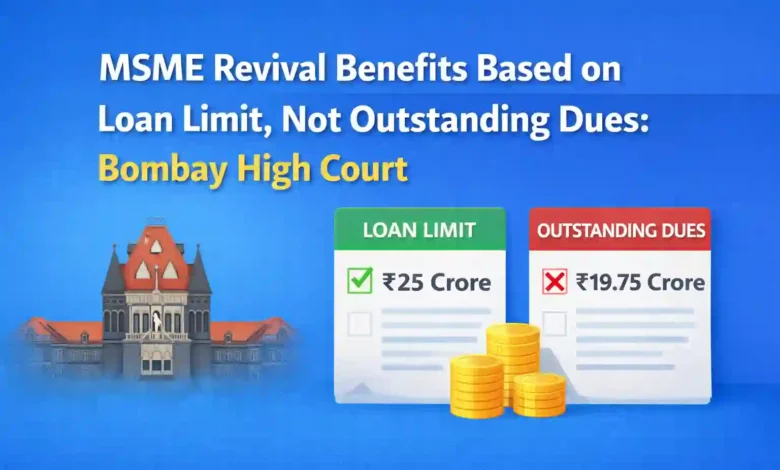
The court said that MSMEs with loans up to ₹25 crore are considered smaller enterprises. Such MSMEs are eligible for protection and assistance under the revival and rehabilitation framework. MSMEs that have taken loans above ₹25 crore are treated as larger enterprises and are not covered under this framework.
The court also noted that banks approve loans only after assessing the borrower’s repayment capacity. Therefore, loans above ₹25 crore are usually given to larger MSMEs.
Vardhan Agro Processing Limited is a registered MSME. It had taken multiple loans from Union Bank of India, including a term loan of ₹30 crore. After its business was affected by the Covid-19 pandemic, the company applied for loan restructuring in March 2022. The bank rejected the request.
Later, the loan account was declared a non-performing asset (NPA) in July 2023. The bank then started recovery proceedings. When the bank approached the National Company Law Tribunal to begin insolvency proceedings, the company moved the High Court.
The company argued that it should get MSME protection because its outstanding dues were around ₹19.75 crore, which is below ₹25 crore. The bank opposed this claim. It said the RBI framework looks at the sanctioned loan limit, not the outstanding amount. It also pointed out that the company’s term loan alone was ₹30 crore.
The High Court agreed with the bank. It held that the ₹25 crore limit applies to the sanctioned loan amount. Since the company had taken a ₹30 crore loan, it was not eligible for MSME revival benefits.
As a result, the court dismissed the petition and allowed the bank to continue insolvency proceedings before the NCLT.
What are RBI Guidelines for Restructuring?
Existing loans to MSMEs classified as ‘standard’ may be restructured without a downgrade in the asset classification, subject to the following conditions:
- The aggregate exposure, including non-fund based facilities, of banks and NBFCs to the borrower does not exceed ₹25 crore as on March 1, 2020.
- The borrower’s account was a ‘standard asset’ as on March 1, 2020.
- The restructuring of the borrower account is implemented by March 31, 2021.
- The borrowing entity is GST-registered on the date of implementation of the restructuring. However, this condition will not apply to MSMEs that are exempt from GST-registration. This shall be determined on the basis of exemption limit obtaining as on March 1, 2020.
- Asset classification of borrowers classified as standard may be retained as such, whereas the accounts which may have slipped into NPA category between March 2, 2020 and date of implementation may be upgraded as ‘standard asset’, as on the date of implementation of the restructuring plan. The asset classification benefit will be available only if the restructuring is done as per provisions of this circular.
- As hitherto, for accounts restructured under these guidelines, banks shall maintain additional provision of 5% over and above the provision already held by them.
- Download Court Order PDF (This PDF is available for Premium Users Only. Click here to join premium)
![DFS PLI Scheme for Senior Executives of Public Sector Banks (Scale IV and Above including Directors) [PDF]](https://hellobanker.in/wp-content/uploads/2026/03/DFS-PLI-Scheme-for-Senior-Executives-of-Public-Sector-Banks-Scale-IV-and-Above-including-Directors-PDF.webp)