Kerala High Court Makes Police Verification Mandatory Before Hearing Bank Account De-Freezing Petitions

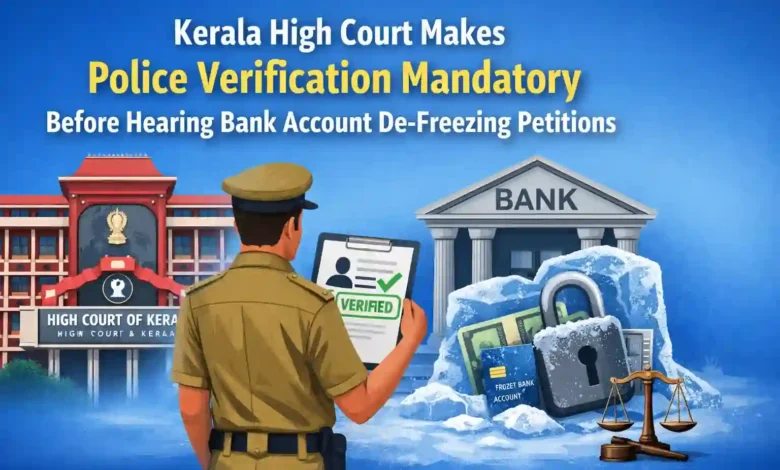
The Kerala High Court has issued a new direction regarding petitions to de-freeze bank accounts. The Court said that the identity of the person filing such a petition must be verified before the case is heard.
Recently, a lot of court cases are being filed by citizens complaining about freezing of accounts by Banks on basis of email or communication received from investigation agencies and police.
The order was passed by a Division Bench of Chief Justice Soumen Sen and Justice Syam Kumar VM. The matter was taken up by the Court on its own (suo motu) under Judicial Practice and Procedure (JPP) proceedings.
The Court directed the Registry not to accept any petition for de-freezing bank accounts unless the Station House Officer (SHO) of the police station in the petitioner’s area is made a party to the case.
The Court also said that before passing any order, the Public Prosecutor must verify the identity of the petitioner through the concerned SHO. The SHO must file an affidavit confirming the identity of the petitioner.
The Court clearly stated that no writ petition or other petition seeking de-freezing of bank accounts will be accepted without including the local SHO as a respondent. It also said that the Public Prosecutor must ensure proper identity verification through the SHO.
The Registrar General has been directed to send a copy of the order to the Director General of Police (DGP) for information and compliance. The order will also be circulated to all judges of the High Court to ensure uniform implementation.
The DGP has been instructed to forward the order to all SHOs, Superintendents of Correctional Homes, and the Deputy Inspector General (DIG) of Prisons for compliance.
The JPP proceeding was started after a single judge noticed a large number of such cases. Many petitions were related to bank accounts frozen in cyber-fraud cases. In many cases, proper details of genuine transactions were not provided. Even the identity of the petitioner was not clearly stated.
In December 2025, the single judge observed that many petitioners claimed they had no role in the crime. They said they received money through genuine business transactions without knowing about the crime. However, in most cases, they did not provide details of such transactions or explain the nature of their business.
Justice MA Abdul Hakhim also expressed concern that the Court was being misused. He said that people involved in cyber fraud were trying to get bank accounts de-frozen by filing petitions with forged documents.
He therefore directed the Registry to ensure that the local SHO is made a party in all such petitions before giving them a case number.
Now, this direction has become part of the Court’s official practice directions through the Division Bench order dated February 13.
- Download Court Order PDF (This PDF is available for Premium Users Only. Click here to join premium)