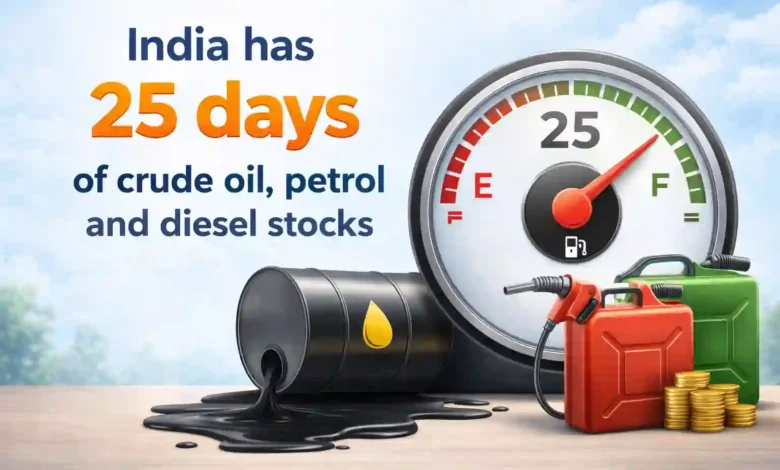
Government sources report India has 25 days of crude oil, petrol, and diesel stocks, plus more for other products, totaling about eight weeks amid fears of disruptions from the U.S.-Israel-Iran conflict. Only 40% of crude imports route through the strait, with steady supplies from Russia and alternatives like West Africa in view. Officials call the position comfortable, backed by strategic reserves for 40 days and over 100 million barrels in commercial stocks.
“We are in a reasonably comfortable position as far as crude oil is concerned,” the source informed, adding, “We have reserves of crude oil for twenty-five days, alongside energy products of twenty-five days as well.”
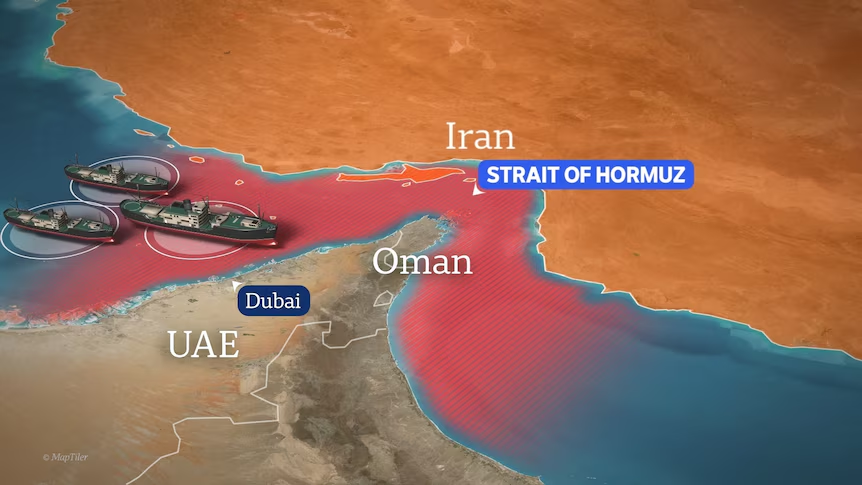
Iran’s Islamic Revolutionary Guard Corps (IRGC), said on Monday that the Strait of Hormuz is “closed” for shipping traffic. It warned that any vessel trying to pass through the key waterway would be set on fire, according to Iranian state media.
India is currently the world’s third-largest crude oil importer, fourth-largest refiner, and fifth-largest exporter of petroleum products. The country maintains sufficient stocks of crude oil as well as key fuels such as petrol, diesel and aviation turbine fuel (ATF), ensuring there is no immediate cause for concern.
India was the third largest crude oil importer in the world in 2024. By value, the following 15 countries were the largest sources of crude oil imports into India, providing 96.9% of all Indian crude oil imported in that year.
| Rank | Country | Import value |
|---|---|---|
| 1 | Russia | $51.3 billion |
| 2 | Iraq | $28.6 billion |
| 3 | Saudi Arabia | $19.3 billion |
| 4 | United Arab Emirates | $13.7 billion |
| 5 | United States | $5 billion |
| 6 | Nigeria | $4 billion |
| 7 | Angola | $3.6 billion |
| 8 | Kuwait | $3.4 billion |
| 9 | Venezuela | $1.8 billion |
| 10 | Colombia | $1.7 billion |
| 11 | Mexico | $1.6 billion |
| 12 | Turkey | $1.4 billion |
| 13 | Oman | $1.3 billion |
| 14 | South Korea | $1.1 billion |
| 15 | Brazil | $1 billion |
How Israel Iran war will impact Crude Oil Supply?
Crude oil is mainly supplied to the world by large oil-producing countries such as Saudi Arabia, Iraq, the UAE, Kuwait, Russia and others. Most of the oil is transported by huge tankers through sea routes. One of the most important routes is the Strait of Hormuz, a narrow waterway between Iran and Oman. Around one-fifth of the world’s oil supply passes through this route every day. Some oil is also transported through pipelines, but sea transport is the most common method because it allows large volumes to move between continents.
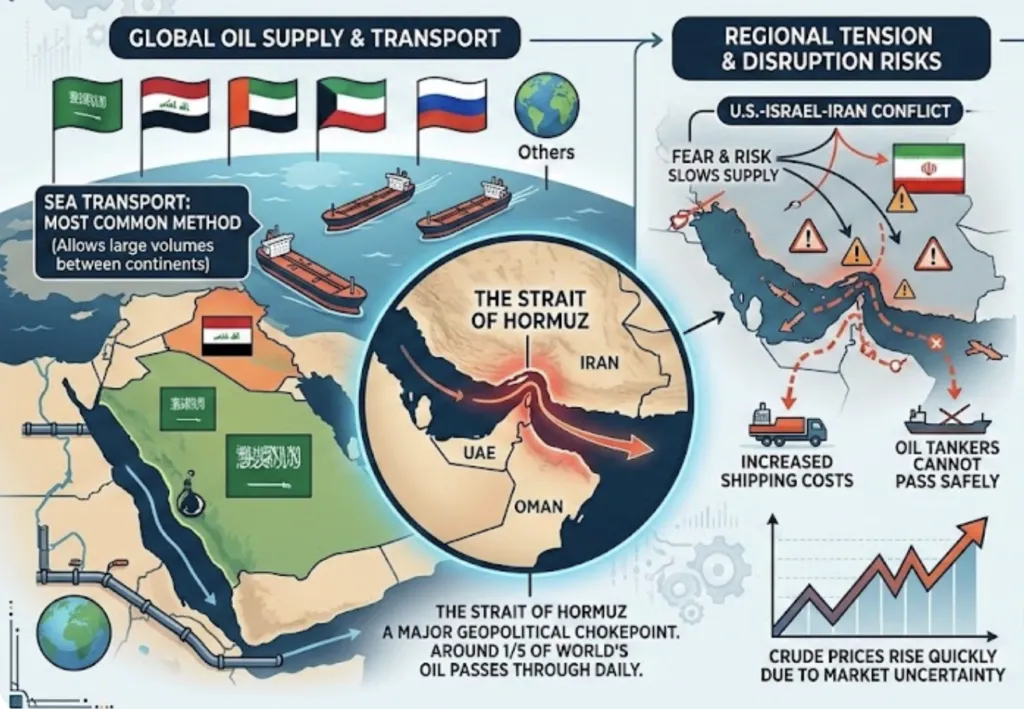
The conflict involving the U.S., Israel and Iran creates tension in the Middle East, which is a major oil-producing region. If the situation worsens and shipping in the Strait of Hormuz is disrupted, oil tankers may not be able to pass safely. Even if the route is not fully closed, fear and risk can slow down supply and increase shipping costs. When global oil supply is threatened, crude prices usually rise quickly because markets react to uncertainty.
If oil prices rise sharply, countries that import large amounts of crude, like India, may face higher fuel costs. This can increase petrol and diesel prices, raise transportation costs and push up inflation. However, the actual impact depends on how long the conflict continues and whether major oil routes remain open. If supply routes stay operational and alternative sources are used, the impact may remain limited.