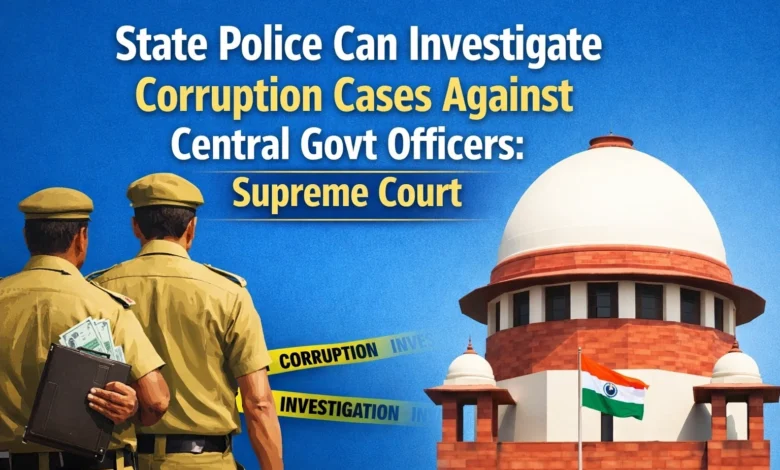
Can State Police Investigate Corruption Cases Against Central Govt Officers? Let’s understand what Supreme Court said on this.
In an important ruling, the Supreme Court has clarified that state police and anti-corruption agencies are fully empowered to investigate corruption cases against Central Government employees. The court said such cases can be registered and chargesheets can be filed without taking prior permission from the CBI.
The decision was delivered on January 19 by a bench of Justices JB Pardiwala and Satish Chandra Sharma. The court upheld a Rajasthan High Court judgment that allowed the Rajasthan Anti-Corruption Bureau (ACB) to investigate a corruption case involving a Central Government officer.
No CBI Approval Needed, Says Court
The Supreme Court made it clear that state investigating agencies do not need approval or consent from the Central Bureau of Investigation (CBI) to register cases under the Prevention of Corruption Act, 1988. It also ruled that a chargesheet filed by a state agency cannot be declared invalid just because CBI permission was not taken.
This ruling settles a long-standing question on whether only the CBI has the authority to investigate corruption cases involving Central Government employees. The court firmly rejected that argument.
Rajasthan ACB Had Full Jurisdiction
The case arose after a Central Government employee challenged the Rajasthan ACB’s authority to investigate him. The High Court had earlier ruled that if a corruption offence is committed within a state’s territory, the state’s anti-corruption agency has the legal right to act, even if the accused is a Central Government employee.
The Supreme Court agreed with this view and held that territorial jurisdiction matters, not the employer of the accused.
Supreme Court Cites Earlier Judgments
To support its ruling, the court referred to its earlier landmark judgment in A.C. Sharma v. Delhi Administration (1973). In that case, the Supreme Court had clearly stated that the law establishing the CBI does not take away the powers of regular state police to investigate corruption offences.
The court explained that the CBI law is empowering, not exclusive, meaning it allows the CBI to investigate certain cases but does not stop state police from doing so under other valid laws.
High Courts Across India Share Same View
The Supreme Court also approved similar rulings by the Madhya Pradesh, Andhra Pradesh, and Kerala High Courts. All these courts had consistently held that state police can investigate bribery and corruption cases against Central Government employees posted within their states.
Final Order
Finding no legal error in the High Court’s decision, the Supreme Court dismissed the appeal filed by the Central Government employee.
Why This Ruling Matters
This judgment strengthens the hands of state anti-corruption agencies and ensures that corruption cases are not delayed due to jurisdictional disputes. It sends a clear message that no public servant is beyond scrutiny, regardless of whether they work for the Centre or the State.
- Download Court Order PDF (This PDF is available for Premium Users Only. Click here to join premium)