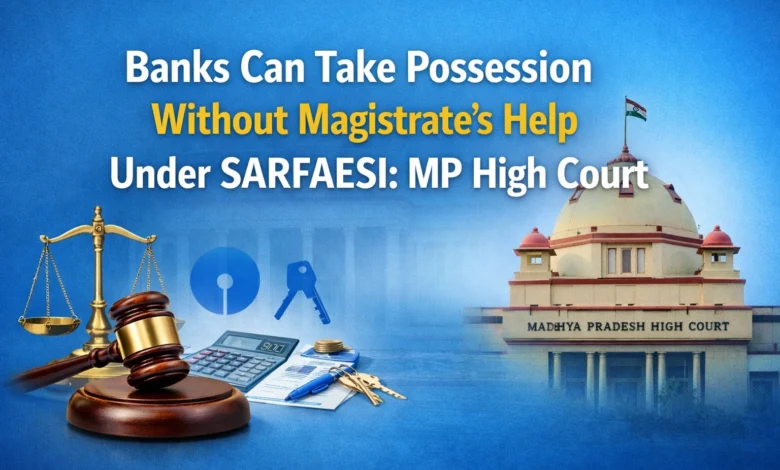
When loans turn NPA, Banks start the process of selling the properties of the loan borrower. Banks need to submit an application to District Magistrate for possession of property. But now Banks can take possession of properties without approaching District Magistrate.
The Madhya Pradesh High Court has ruled that a secured creditor does not always need to approach the District Magistrate or the Chief Metropolitan Magistrate under Section 14 of the SARFAESI Act before taking physical possession of secured assets.
The Court said that a bank can take possession directly if it has followed the legal steps under Sections 13(2) and 13(4) of the SARFAESI Act. A Division Bench of Justice Anand Pathak and Justice Pushpendra Yadav passed this order.
Also Read: RBI imposed penalty on Punjab National Bank for shortage of notes at currency chest
The High Court set aside earlier orders passed by the Debt Recovery Tribunal, Jabalpur and the Debts Recovery Appellate Tribunal, Allahabad. These tribunals had directed UCO Bank to return possession of mortgaged properties to the borrower and refund the auction purchaser’s deposit.
Disagreeing with the tribunals, the High Court said that the SARFAESI Act does not make it compulsory to use Section 14 in every case. The Court clarified that a bank needs to approach the magistrate only when it requires assistance to take possession.
The Bench explained that Section 13(4) itself gives power to a secured creditor to take possession of secured assets after issuing the required notices. Section 14 is only an enabling provision. It is meant to provide administrative help when resistance is faced.
Also Read: Big News! Govt planning to increase FDI Limit in PSU Banks
The Court held that an authorised bank officer can take physical possession of the secured asset on his own. It also said that there is no legal requirement for the borrower, mortgagor, or guarantor to be present at the time of taking possession. If they are not present, possession cannot be treated as forcible.
The Bench said that the only legal requirement is to serve notices under Sections 13(2) and 13(4) of the SARFAESI Act on the borrower.
In this case, the borrower had taken a cash credit loan of ₹5 crore from UCO Bank. The loan was secured by two properties—one industrial unit and one residential property. After default, the account was classified as a non-performing asset in October 2018.
Also Read: IDBI Bank Staff announce strike on 9th March against Privatisation of Bank
The bank issued a demand notice under Section 13(2), followed by a possession notice under Section 13(4). These notices were also published in two newspapers. Before taking physical possession, the bank issued another notice to the borrower.
The borrower then approached the DRT, claiming that the bank had taken possession without invoking Section 14 and with police help. The DRT accepted this argument and ordered the bank to return the properties and refund the auction deposit. The DRAT later upheld this decision.
Allowing the bank’s petition, the High Court said the tribunals were wrong in treating Section 14 as mandatory. The Court noted that the properties were not occupied at the relevant time and no resistance was offered. This fact was recorded in the panchnama.
Also Read: Top Mutual Funds with High Returns in February 2026
Relying on Supreme Court rulings, the High Court said that a secured creditor can take possession directly under Rule 8 of the Security Interest (Enforcement) Rules, 2002, if there is no resistance. The magistrate’s help is needed only when assistance is required.
The Court clarified that once possession is already taken by the bank, there is no need to start proceedings under Section 14. It then set aside the DRT and DRAT orders and allowed the bank to continue recovery proceedings as per law.
- Download Court Order PDF (This PDF is available for Premium Users Only. Click here to join premium)