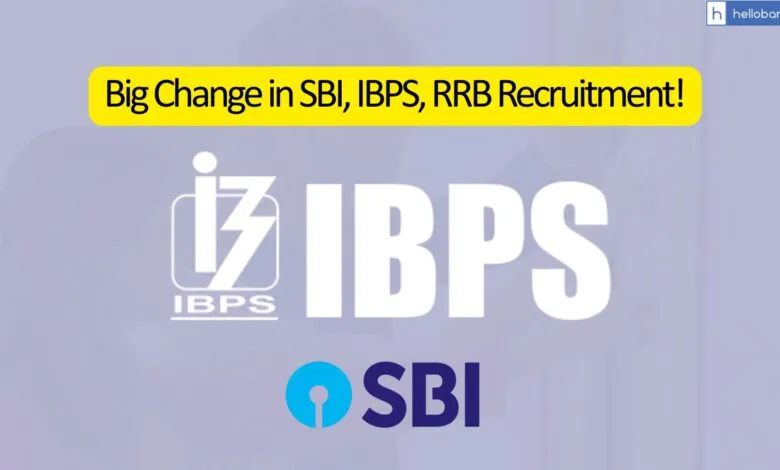
Big Change in SBI, IBPS, RRB Recruitment! Govt Changes Rules to Stop Job Switching by Candidates

The Department of Financial Services (DFS) under the Ministry of Finance has announced a major change in how recruitment and results will be handled for SBI, nationalised banks and Regional Rural Banks. The government wants to stop candidates from switching between bank jobs.
At present, candidates appear for SBI, IBPS, and RRB exams, including SBI PO, SBI Clerk, IBPS PO, IBPS Clerk, RRB PO, and RRB Clerk. When a candidate is selected for an RRB Clerk position, they join the job, but if the PO results are announced later and they qualify, they leave the clerk job to join as a PO. Similarly, if someone is selected as an RRB PO but later clears the IBPS PO exam, they resign from the RRB PO post and join IBPS PO. The same pattern continues—if a candidate selected as an IBPS PO later qualifies for SBI PO, they leave the IBPS position to join SBI.
This happens because RRB results are declared first, followed by IBPS, and finally SBI, leading candidates to move from one job to another as better opportunities open up. As a result, banks face high attrition at the entry level, which creates staffing challenges and operational difficulties.
To fix this, the government has changed the entire result sequence. From now on, SBI results will be declared first, followed by nationalised banks, and then RRBs. Within each group, officer results will come before clerical results so that candidates can clearly understand their choices and decide wisely.
Example:
Rahul appears for RRB Clerk, IBPS PO, and SBI PO exams. Since RRB declares its results first, he gets selected and joins the RRB job because he does not want to remain unemployed. A few weeks later, IBPS announces its PO results, and Rahul gets selected again. Because the IBPS PO job is better, he resigns from RRB and joins IBPS. Later, when SBI finally declares its PO results, Rahul gets selected for SBI as well. Since SBI is his first preference, he resigns from IBPS and joins SBI. This constant shifting creates a big problem for banks because they lose newly hired staff repeatedly. As a result, vacancies keep getting created in IBPS and RRB banks, leading to a shortage of staff and difficulty in maintaining smooth operations. If SBI declared its results first, Rahul would join SBI directly and would not join RRB or IBPS at all. Then RRB and IBPS could fill their vacancies using reserve lists, reducing resignations and ensuring more stable staffing.
Example:
Suppose 100 candidates appear for RRB, IBPS, and SBI exams. Since RRB announces its results first, around 100 candidates who qualify join RRB because they do not want to wait without a job. After some time, IBPS announces its PO results. Out of these 100 candidates, 60 get selected in IBPS PO. Since IBPS PO is considered a better job, all 60 candidates resign from RRB and join IBPS. Now RRB suddenly faces 60 vacancies and a major staff shortage.
A few months later, SBI announces its PO results. Out of the same group, 30 candidates get selected for SBI PO. SBI is the top preference for most aspirants, so all 30 resign from IBPS and join SBI. This leaves IBPS with 30 new vacancies and a shortage of staff even after spending time and resources on recruitment and training.
In this example, RRB loses 60 officers and IBPS loses 30 officers within a short period. Such large-scale movement creates continuous vacancies, disrupts branch operations, and puts pressure on remaining staff. If SBI declared results first, these 30 candidates would join SBI directly, and IBPS and RRB could fill roles using reserve lists, reducing resignations and stabilizing manpower.
Right now, most candidates prefer to work in SBI first, then in IBPS banks, and lastly in RRBs. Because of this preference, the order in which exam results are announced creates a big problem for banks.
At present, RRB results come out first. So, candidates who qualify for RRB join RRB jobs. After a few weeks or months, IBPS results are declared. Many of those candidates who had already joined RRB now leave their RRB job and move to an IBPS bank because they consider it a better opportunity. Later, when SBI results are declared, candidates leave their IBPS jobs and join SBI, as SBI is their first choice.
This constant shifting from RRB to IBPS and then from IBPS to SBI creates a long chain of resignations. It increases attrition at the entry level, and banks struggle with vacant positions and staffing shortages.
If SBI announces its results before IBPS and RRB, then the situation will improve. Candidates who qualify for SBI will join SBI immediately and will not join IBPS or RRB at all. Then, IBPS and RRB can fill their remaining vacancies through their reserve lists, without losing staff later. This will reduce job-hopping and help all banks maintain proper staffing.
In another big step towards transparency, IBPS will start giving candidates online access to their response sheets and answer keys from the 2026–27 recruitment cycle. This will help candidates understand their performance better and build trust in the exam process.
According to DFS, these reforms will make bank hiring more predictable, reduce unnecessary movement between jobs, and strengthen workforce planning across the entire banking sector.