
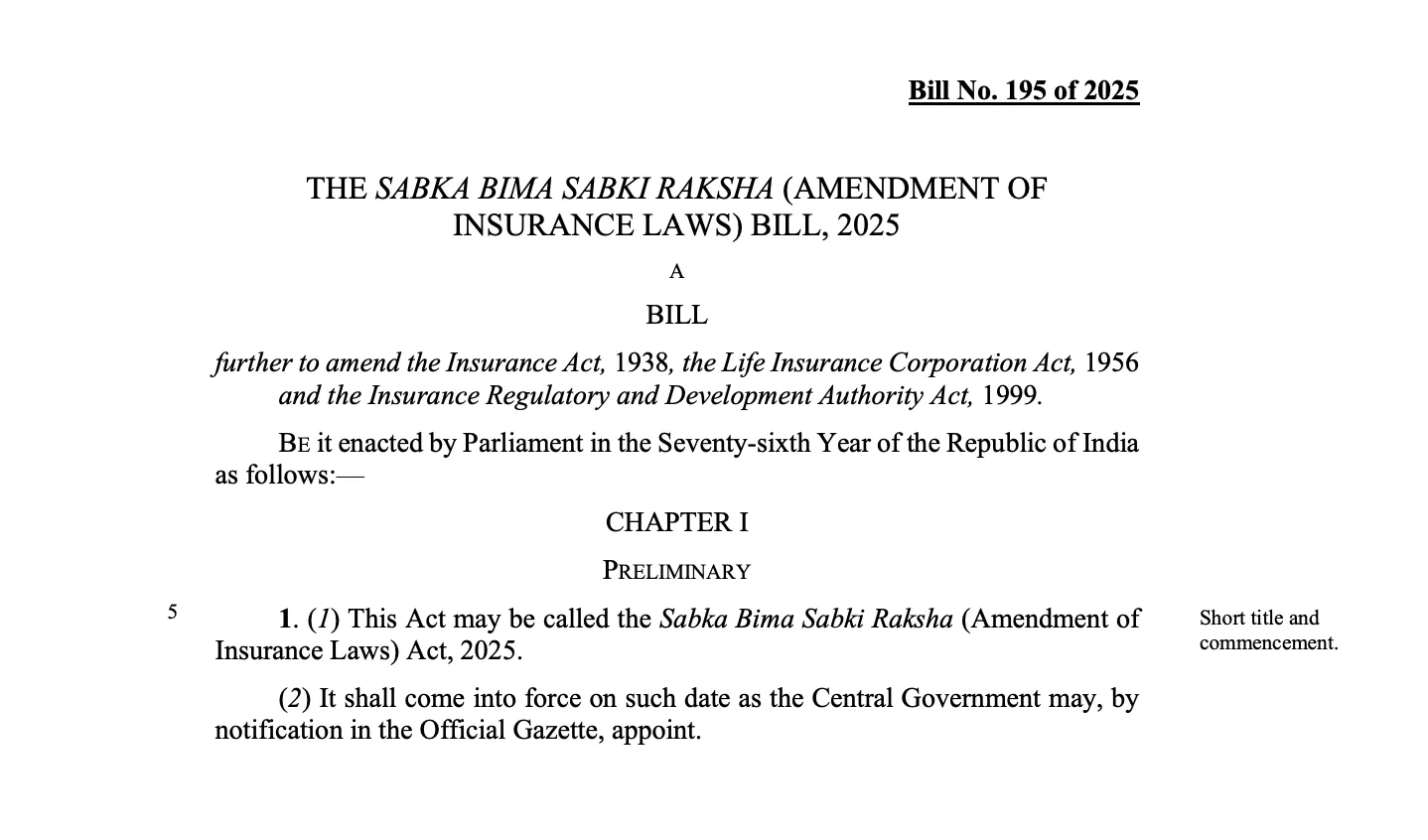
The Sabka Bima Sabki Raksha (Amendment of Insurance Laws) Bill, 2025 was introduced in Lok Sabha on December 16, 2025. The bill was passed in Lok Sabha on December 16, 2025 and in Rajya Sabha on December 17, 2025. It seeks to amend the Insurance Act, 1938, the Life Insurance Corporation Act, 1956, and the Insurance Regulatory and Development Authority Act, 1999. The Bill proposes to increase the Foreign Direct Investment (FDI) limit in Indian Insurance companies from 74% to 100% of the paid-up equity capital.
The Bill seeks to amend three major laws:
- The Insurance Act, 1938
- The Life Insurance Corporation Act, 1956
- The Insurance Regulatory and Development Authority Act, 1999
100% Foreign Investment Allowed in Insurance Companies
The Bill proposes to increase the Foreign Direct Investment (FDI) limit in Indian insurance companies from the current 74% to 100% of the paid-up equity capital.
Lower Capital Requirement for Foreign Re-insurers
Foreign companies involved in re-insurance currently need a net-owned fund of ₹5,000 crore to operate in India. The Bill reduces this requirement to ₹1,000 crore, making it easier for foreign re-insurers to operate.
(Net-owned fund includes paid-up capital, free reserves, share premium balance, and capital reserves from surplus.)
Change in Rules for Transfer of Shares
Under the current rules, insurance companies must get IRDAI approval if the share transfer value exceeds 1% of paid-up capital. The Bill increases this limit to 5%, allowing easier share transfers without IRDAI approval.
Minimum Capital Requirement Removed for Co-operative Insurers
Earlier, insurance co-operative societies needed at least ₹100 crore paid-up capital for life, health, or general insurance businesses. The Bill removes this requirement.
Application of Insurance Act to Insurers in SEZs and IFSCs
The central government already has the power to relax or modify rules for insurers in Special Economic Zones (SEZs). The Bill extends these powers to:
- International Financial Services Centres (IFSCs) in SEZs
- Insurance intermediaries operating in SEZs and IFSCs
Expanded Definition of Insurance Intermediaries
Currently, intermediaries include brokers, consultants, and third-party administrators. The Bill adds:
- Managing General Agents (MGAs)
- Insurance repositories
More Powers for IRDAI
The Bill strengthens the role of the Insurance Regulatory and Development Authority of India (IRDAI). New powers include:
- Approving arrangements between insurers and companies not engaged in insurance
- Superseding the Board of Directors of an insurer and appointing an Administrator if policyholders’ interests are at risk
- Setting rules for commissions, rewards, and payments to agents or intermediaries
- Inspecting and investigating intermediaries as well
Policyholders’ Education and Protection Fund
The Bill creates a new Policyholders’ Education and Protection Fund, managed by IRDAI. This fund will be used to:
- Protect policyholders’ interests
- Educate consumers about insurance
The fund will get money from:
- Grants from central/state governments, IRDAI, and companies
- Penalties collected by IRDAI
- Other amounts specified through regulations
-

-
![PNB Bank Guidelines for Directors [PDF]](https://hellobanker.in/wp-content/uploads/2025/06/PNB-Bank-Guidelines-for-Directors-PDF-390x220.webp)
-

-
-
-
-
-
-
-
-
-

