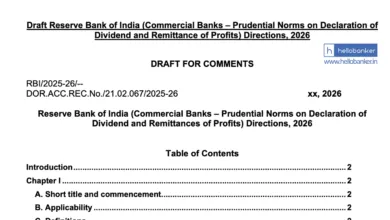
The RBI has released new guidelines for Declaration of Dividend and Remittances of Profits by Banks. These Directions shall come into effect from Financial Year (FY) 2026-27. These Directions shall be applicable to all Banks. If a bank declares a dividend, then the report shall be furnished to the Department of Supervision of the Reserve Bank of India (RBI) within a fortnight.
A dividend is a part of a company’s profit that is distributed to its shareholders. When a company or bank earns profit, it can either reinvest the money in the business or share a portion of the profit with its investors. The amount paid to shareholders from this profit is called a dividend.
For example, if you own shares of a bank and the bank declares a dividend, you will receive money based on the number of shares you hold.
In the case of banks in India, the Reserve Bank of India (RBI) sets guidelines on how much dividend a bank can declare. These rules ensure that banks maintain strong capital and financial stability before distributing profits to shareholders.
Eligibility Criteria: Which Banks can declare Dividends?
A bank shall meet the following prudential requirements, to be eligible to declare dividends or remit profits.
- The bank was in compliance with the applicable regulatory capital requirement as at the end of the previous financial year and shall continue to be in compliance as at the end of the financial year during which the dividend is proposed to be paid.
- The regulatory capital of the bank shall not fall below the applicable regulatory capital requirement even after the payment of dividend.
- The bank incorporated in India shall have positive adjusted Profit After Tax (PAT) for the period for which the dividend is proposed.
- A foreign bank operating in India in the branch mode, shall have positive PAT for the period for which the profits are to be remitted to the Head Office.
- The bank shall not be under any explicit restrictions for declaration of dividends or remittance of profits from the Reserve Bank or any other authority.
How much Dividends Banks Can Pay?
A bank which satisfies the eligibility criteria given above, may declare and pay dividend up to the limits prescribed below, but in aggregate not exceeding 75% of the PAT for the period for which the dividend is being proposed.
Example of Dividend Payment
| Particulars | Amount (₹ Crore) |
|---|---|
| Net profit (PAT) for FY 20X1-X2 (A) | 17,000 |
| Net NPAs as on March 31, 20X2 (B) | 6,500 |
| Adjusted PAT, i.e., (C) = (A) – 50% of (B) | 13,750 |
| CET 1 ratio capital as on March 31, 20X1 (D) | 11.72% |
| The CET1 ratio falls in bucket B3 | |
| 75% of PAT (E) | 12,750 |
| Max payable as per Table 1 (30% of 13,750) (F) | 4,125 |
| Maximum Eligible Dividend (i.e., Lower of E or F) | 4,125 |
| Maximum Eligible Dividend as percentage of PAT | 24.26% |
Remittance of profits by foreign banks operating in India in branch mode
A foreign bank operating in India in branch mode, that satisfies the eligibility criteria, may remit net profit / surplus (net of tax) earned in the normal course of business arising out of its Indian operations, without prior approval of the Reserve Bank, subject to the conditions that the accounts of the bank are audited and in the event of excess remittance, if any, the Head Office of that foreign bank immediately shall return the excess remittance and make good the shortfall.
The following profits shall not be available for payment of dividend / repatriation of profit by foreign banks operating in India in branch mode:
- Any exceptional and / or extra-ordinary profits / income shall not be available for payment of dividend / remittance of profit by foreign banks operating in branch mode in India.
- If the audit report by the statutory auditor contains a modified opinion that indicates an overstatement of the PAT, the same shall not be available for payment of dividend / remittance of profit by foreign banks operating in branch mode in India, to the extent it is included in PAT.
- A bank shall not pay dividend or repatriate profits out of net unrealised gains arising on fair valuation of Level 3 financial instruments (including derivatives).
Click here to download RBI Circular
-

-

-

-

-
-
-
-
-

-
-
-