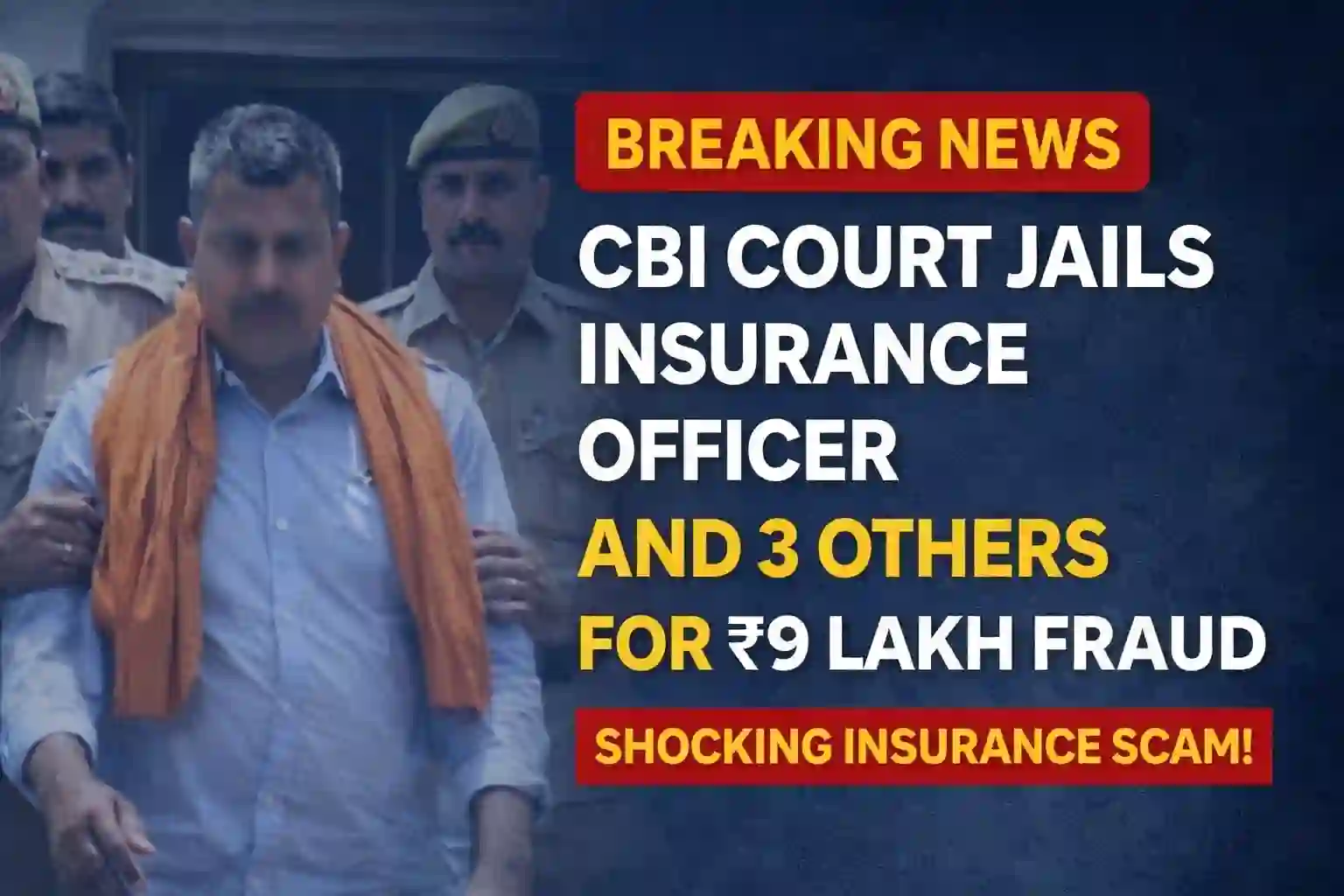
The Central Bureau of Investigation (CBI) Court in Lucknow has convicted four people, including an insurance company officer, in a fake insurance claim case involving more than ₹9 lakh. The judgment was delivered on 16 January 2026, and the case relates to fraud committed during the years 1999 to 2002.
The main accused, N.K. Singhal, who was working as an Administrative Officer (Development) at New India Assurance Company Ltd., Divisional Office-III, Kanpur, has been sentenced to three years of imprisonment along with a fine of ₹2.3 lakh. Two other accused, Sanjay Kumar Jain and Neeraj Kapoor, were also sentenced to three years in jail, each with a fine of ₹95,000. Another accused, Brijesh Kanodia, was sentenced to two years of imprisonment with a fine of ₹25,000.
According to the CBI, the case was registered on 30 January 2004 after it was found that N.K. Singhal, while serving as an Administrative Officer, entered into a criminal conspiracy with other individuals. The accused allegedly committed cheating, forgery, and criminal misconduct by processing fake insurance claims, causing a financial loss of approximately ₹9,81,840 to New India Assurance Company Ltd.
After completing the investigation, the CBI filed a chargesheet on 30 November 2005 against N.K. Singhal, Neeraj Agarwal, Sanjay Kumar Jain, Pradeep Kumar Dixit, Neeraj Kapoor, Amar Nath Shukla, and Brijesh Kanodia. N.K. Singhal was also charged under provisions of the Information Technology Act, 2000.
Following a detailed trial, the court found sufficient evidence against four accused and convicted them accordingly. However, Pradeep Kumar Dixit was acquitted of all charges by the court. In addition, proceedings against Neeraj Agarwal, Assistant Manager at NIAC, DO-3, Kanpur, and Amar Nath Shukla were closed due to their death during the trial.
The case highlights serious misuse of official position and fraudulent practices in the insurance sector. The CBI stated that investigations and legal action against financial crimes remain a priority to ensure accountability and protect public institutions from losses.
-

-
-
-

-

-

-

-
-

-

-
-